Local & Seasonal
Why Does My House Smell Musty in San Diego?
A musty odor in a San Diego house is usually moisture, not dirt. Here is how to tell ordinary dampness from a mildew smell that points to hidden mold, and what to check first.
Read article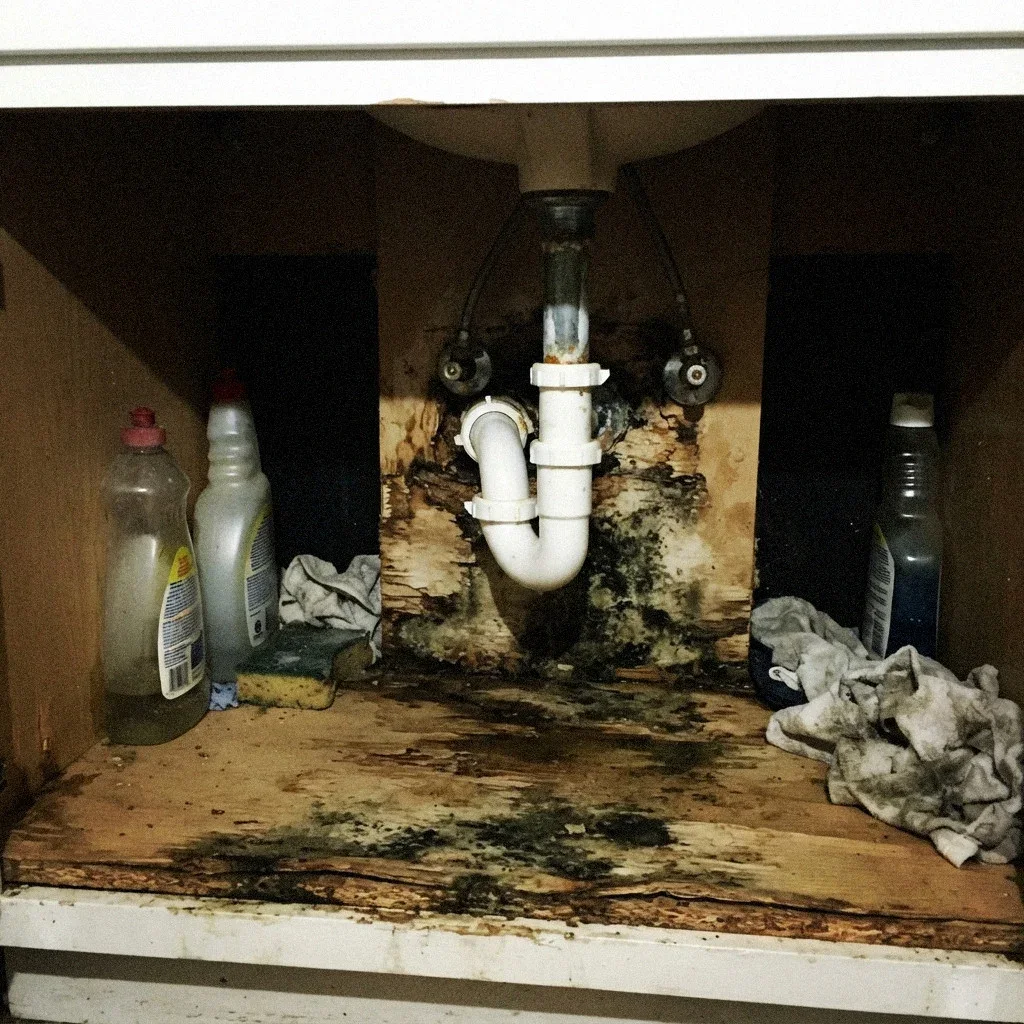
Under the sink, behind the fridge, inside the cabinet backing.
Under the sink in a Clairemont bungalow, or behind the fridge in a North Park kitchen, the same pattern shows up: a dark ring on the cabinet floor, a soft spot in the particleboard, a smell that gets stronger with the dishwasher running. Kitchens along El Cajon Boulevard and out toward Linda Vista sit on the same supply lines and the same porous cabinet backing, and none of it needs a storm to fail.
A pro starts at the supply valves under the sink, then the dishwasher hose, then the fridge line, because a slow drip there can soak cabinet backing for months before it darkens. Emptying the cabinet and pulling contents clear of food-prep surfaces comes first, since porous shelving and any open food get treated as contaminated. Price turns on whether the particleboard carcass gets cut out or dried, and whether the leak behind the splashback has already reached the wall behind it.
Across San Diego County, whether you're in Kensington, University Heights, City Heights, or elsewhere around San Diego, kitchen & cabinet mold removal is worth arranging with somebody who works on this housing stock rather than a generic plan. Foundation type, soil and building age all change what has to happen first.
This is most often a home job — residential mold removal sets out what that involves, or see commercial mold removal if the property is a business or a rental.
A musty smell that is strongest with the cabinet doors closed and fades when they're open is the clearest sign. It means the air inside the cabinet carcass is different from the air in the kitchen, which usually means moisture is sitting against the particleboard back panel rather than evaporating into the room. Open every base cabinet along one wall and compare.
Warped or delaminating particleboard at the back or bottom of a sink cabinet, especially where it meets the wall, points to a slow supply line or drain leak rather than a one-time spill. Spilled water dries. A leak that's been dripping for weeks swells the board, lifts the laminate edge, and leaves it soft enough to flex under a fingertip.
Dark speckling on the wall behind a refrigerator or dishwasher, visible once the appliance is pulled out, usually traces back to a condensate line or a supply connection that has been seeping quietly against the wall board. Because the appliance hides it, this pattern is often found only when the unit is replaced or serviced, not when the mold started.
The licensed pros we connect you with trace the water first: supply lines, the dishwasher connection, an icemaker line, or condensate from the refrigerator, before touching any growth.
Affected cabinets and drawers are emptied, with food-contact items sorted for discard or cleaning separately from tools and cookware that just need a wipe-down.
Swollen or crumbling particleboard backing, and any wall material behind a leaking splashback, is removed rather than treated, since that material doesn't dry back to normal.
Cabinet interiors and the surrounding wall are dried and cleaned, and the leak source is confirmed fixed before anything is closed back up or reinstalled.
Kitchens in San Diego's older housing stock sit on slab or over a raised crawl space, with cabinet boxes built from particleboard or MDF that swells and blooms the moment a supply line under the sink starts seeping. Nobody checks under there daily. By the time a smell reaches the kitchen, the cabinet backing and the wall behind it have usually been wet for months.
San Diego kitchens rarely flood the way a burst pipe does elsewhere; the more common pattern here is a supply line to an icemaker or dishwasher that seeps for months without anyone noticing, because the leak is inside a cabinet nobody empties. Homes near Mission Valley and Clairemont with original 1950s-1970s kitchen plumbing see this often.
Coastal neighborhoods like Ocean Beach and Pacific Beach carry more ambient humidity into the kitchen air even without a leak, which is why a sink cabinet with no obvious drip can still grow mold on its back panel. Inland areas such as El Cajon and Santee run drier air, so the same cabinet there more often points straight to an active leak.
These are the figures we quote most often for kitchen & cabinet mold removal. Size of the property and how far the problem has spread move the number.
| Best Suited For | What It Finds | What It Misses |
|---|---|---|
| A house near the coast can go all summer without a drop of rain and still grow mold on a closet wall, because the trigger here is marine air condensing on a cool surface, not storm water. Inland toward El Cajon Boulevard the air runs drier, so the same house behaves differently a few miles apart. | Drying for a limited, easy-to-reach area | an estimated $425–$1890 |
| Houses built in different decades fail in different ways. Older bungalows with single-pane windows condense differently than a 1960s tract house on a mesa, and a 1980s build with central air has its own condensate paths. Housing era predicts the moisture problem more than the neighborhood does. | HEPA cleaning for one affected room | an estimated $500–$2700 |
| The marine layer that cools San Diego mornings in summer is the same humidity that condenses on a cold window or an air conditioning line. Locally this is May Gray and June Gloom, and it is a mold driver most homeowners never connect to their own patch of growth. | Several rooms or a hard-to-reach cavity | an estimated $750–$4320 |
| A dry climate does not mean a dry house. Slab foundations and crawl spaces trap moisture differently than the wet-season markets most mold advice is written for, so guidance built for a rainy climate does not transfer cleanly to a city where the mold driver is humid air, not rainfall. | Multiple containment zones and extensive removal | an estimated $1200–$7200 |
Cost swings less with the color or smell than with how the leak or condensation got found and stopped. Two jobs of the same size can price apart because one crew opened a wall to trace a drip and the other sprayed the surface and left, which shows up later as a callback nobody wanted.
Only the cabinets and drawers directly affected, plus anything stored against a shared wall. Food-contact items inside an affected cabinet are treated as contaminated if mold has been growing nearby and get discarded or professionally cleaned before returning; unopened cans and sealed jars are usually fine after wiping down.
Open food, anything in a cardboard box, and items stored in the affected cabinet should be moved out or discarded before work starts. Sealed refrigerated and pantry items elsewhere in the kitchen are typically fine to leave, but the licensed pros we connect you with will tell you exactly which cabinets need clearing first.
Cabinet backing is almost always particleboard or MDF, both of which are wood pulp pressed with glue rather than solid wood, and both absorb water like a sponge and never fully recover. Once it has swollen and crumbled, it needs replacing rather than drying out, because the fibers themselves have broken down.
A remediation job that doesn't trace the water source is only cleaning the surface. The licensed pros we connect you with should check the supply lines, the dishwasher connection, and any icemaker line before treating growth, because mold returns on the same cabinet within weeks if the leak behind it is never fixed.
Bleach changes the color of what you can see but doesn't remove growth from inside porous particleboard, so it looks clean for a while and comes back. On a wood cabinet frame it also can't reach mold that has spread into the panel itself, which is why the backing usually needs to come out rather than be treated in place.
A single cabinet with a contained leak is often a one-day job once the source is fixed. Where mold has spread behind a tiled splashback or into the wall board behind the sink, expect it to run longer, since that material has to be opened up, dried, and in some cases replaced before the cabinet goes back.
Testing gets asked for a lot, and it is usually the wrong first step. If you can see the patch and smell the musty air, spending money to confirm what you already know skips the harder question: where is the moisture coming from. Fix that source first, then decide whether cleanup needs a professional at all.
Marine air carries moisture year round here, and a cool interior surface is enough to turn it into growth, no storm required. Single-glazed windows, closet walls behind furniture, and cold supply ducts all condense quietly. The pattern is mechanical, not seasonal, which is why a home can develop a mold problem in the driest month on the calendar.
A musty odor in a San Diego house is usually moisture, not dirt. Here is how to tell ordinary dampness from a mildew smell that points to hidden mold, and what to check first.
Read articleThis is one piece of a larger job, and it rarely stands alone. A leak that stains a ceiling in Kensington or a condensation line in a Pacific Beach bathroom usually needs both the moisture stopped and the growth removed, in that order. The licensed pros we connect you with in San Diego can tell you on the call whether this service covers what you're dealing with or whether the source needs attention first. Call Now: (619) 833-1053 and describe what you're looking at.
Call (619) 833-1053