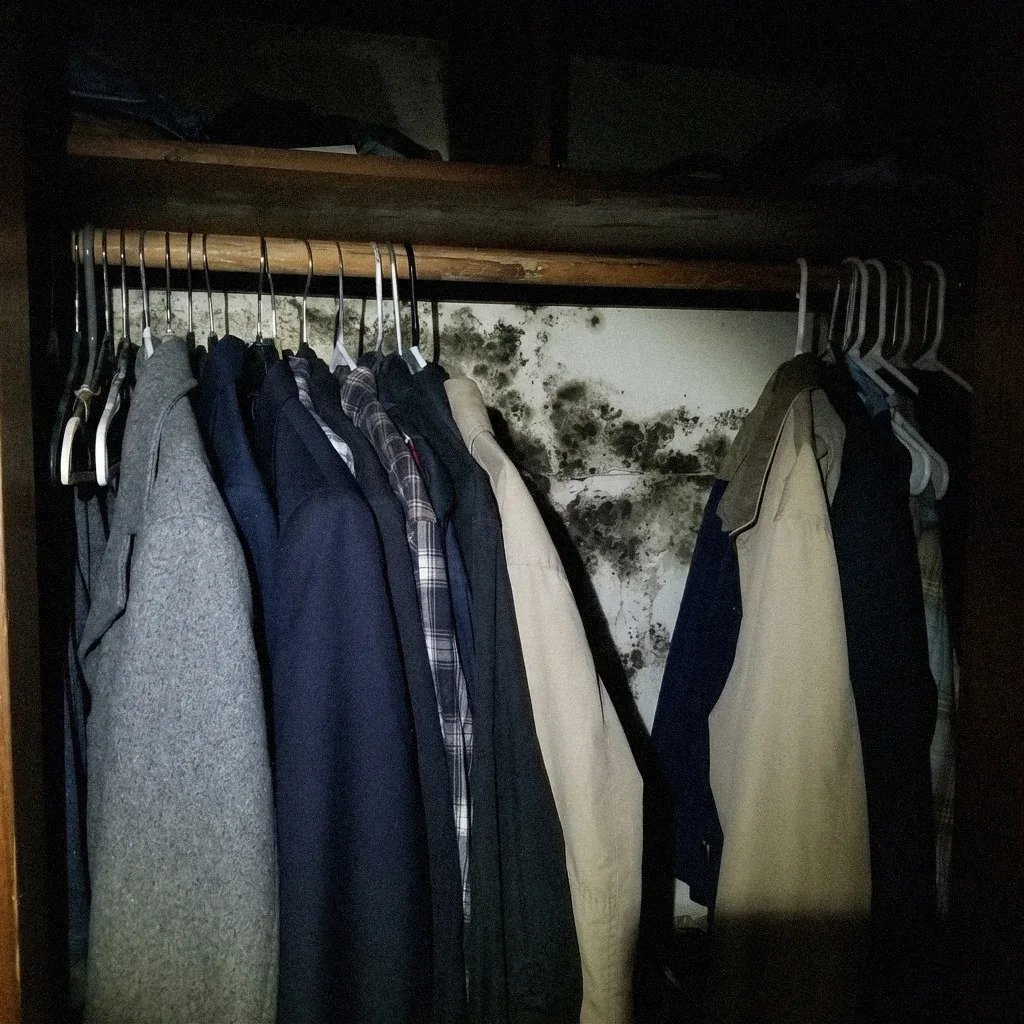
A closet on an exterior wall is usually the coldest, stillest air in a San Diego house. The wall behind it faces outside, so it runs a few degrees cooler than an interior partition. Nothing moves that air, no supply vent reaches it, no door stays open. Add clothing, boxes or shoes pressed against the plaster, and you have a small, undisturbed pocket where humid air can sit on a cool surface for hours at a stretch. That is the beginning of the pattern, not the leak most people go looking for.
Still Air, Cool Plaster
Warm air holds more moisture than cool air. When humid air inside a closet touches an exterior wall that is several degrees cooler than the room, some of that moisture gives up and settles on the surface as a thin film. In a bedroom with a ceiling fan or an open window, that film evaporates again. Inside a closed closet it often does not, because there is no airflow to carry it away. The result is a wall that stays faintly damp long after the rest of the room feels dry.
Why Exterior Walls Run Cold
An exterior wall loses heat to the outside air on one side while holding room-temperature air on the other. In older San Diego houses built before better insulation was standard, that temperature gap is wider than most owners expect. A closet wall shares the same construction as the window wall a few feet away, but nobody watches it, because a window shows condensation on the glass and a closet wall hides its dampness behind hanging clothes.
Marine Air Without Rain
Look at the closet on the north side of a Kensington or Talmadge bedroom, tucked against an exterior wall. The door stays shut, air barely moves, and the wall behind the hanging clothes stays a few degrees cooler than the room. Marine humidity works into that gap, meets the cold plaster, and settles there instead of drying off. Nobody notices because nobody looks. The same setup shows up in a linen cabinet backed onto siding in a University Heights bungalow.
What Stored Contents Do
Boxes, folded linens and stacked shoes pushed flush against a closet wall block the small amount of air movement the space would otherwise have. They also hold their own moisture from fabric and cardboard, and they insulate the wall from the room's temperature just enough to keep the cold surface colder. A gap of even a few inches between stored items and the wall lets air circulate and lets that surface warm closer to room temperature, which is often enough to stop condensation from forming in the first place.
The First Signs to Notice
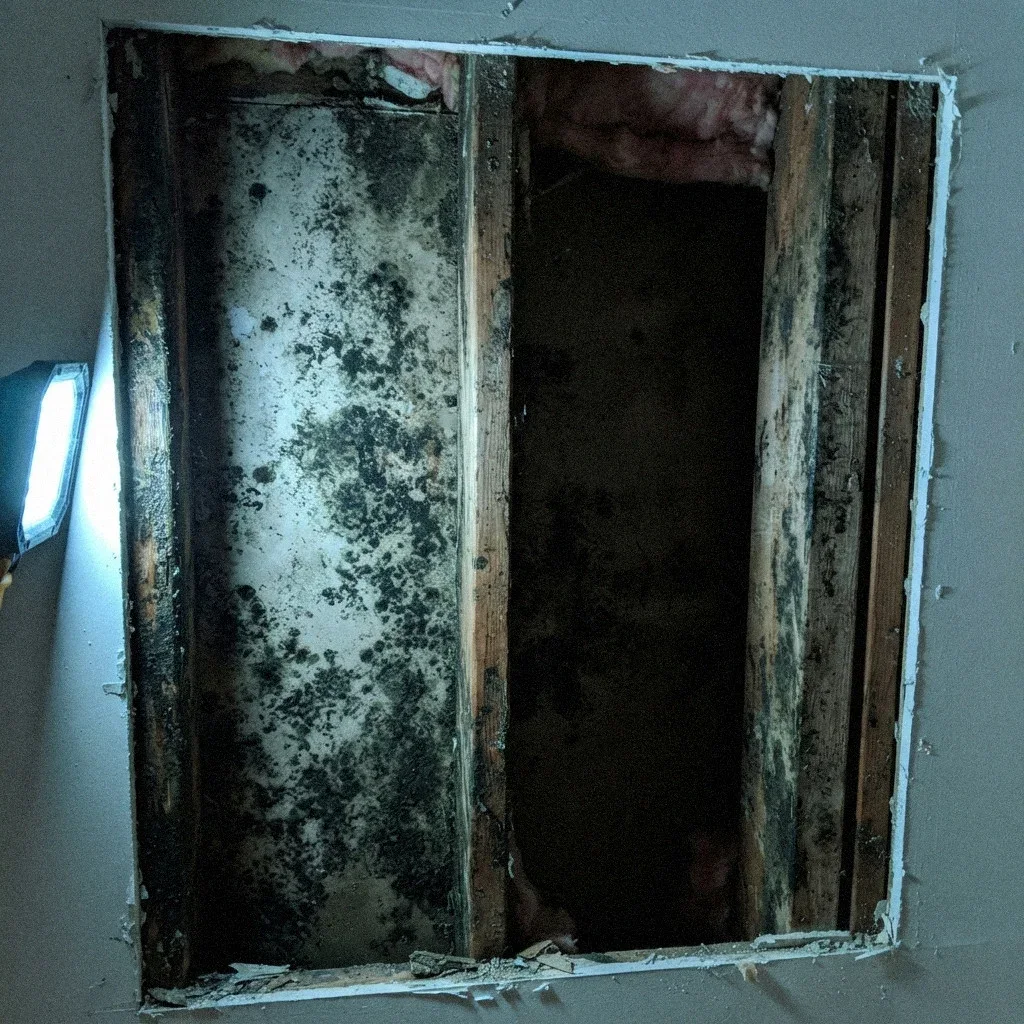
Growth in this kind of closet usually starts low, near the baseboard, or in a corner where two exterior walls meet. It shows as a dusty gray or black patch on drywall, sometimes on the back of a hung garment or a cardboard box lid facing the wall. A musty smell often arrives before any visible patch does, because the smell comes from the same microbial activity that will eventually produce a stain. Neither the smell nor the color tells you which species is growing; color is not a reliable identifier for anything on a wall.
Bedroom Closets Versus Hall Closets
A bedroom closet on an exterior wall behaves differently from an interior hall closet, which usually backs onto another room rather than the outside. The hall closet stays close to indoor temperature on both sides and rarely grows anything unless a pipe or roof leak feeds it. The bedroom closet's exposure to outside temperature is the entire difference, and it is why two closets in the same house can have completely different histories even though nobody treats them differently day to day.
Furniture Pushed to the Wall
The same mechanism shows up outside closets wherever furniture sits flush against an exterior wall: a headboard, a dresser, a bookcase in a converted bedroom. Any solid object blocking airflow to a cool exterior wall recreates the closet problem without a door to hide it behind. Owners in older San Diego neighborhoods with solid masonry or plaster construction, rather than newer stucco-over-frame walls, tend to see this more, since those walls often run cooler on the interior face.
Drying Guidance That Applies
The fix has less to do with cleaning and more to do with airflow. Pull stored boxes and off-season coats a few inches off that exterior wall, leave the closet door cracked when the room is occupied, and let a small fan or the house's own air movement reach the back corner. The EPA's guidance is to get a damp surface fully dry within two days; a closet that never sees moving air cannot meet that window on its own.
Simple Changes That Help
This pattern is not particular to one San Diego neighborhood. It shows up in older Clairemont ranch houses, in Normal Heights bungalows with plaster walls, and in Serra Mesa homes built the same era, wherever a closet backs onto the outside instead of an interior hallway. If the growth has already spread past a small patch, our mold remediation process guide covers the removal process itself; this page is only about why that particular wall started first.
When It Is Already a Patch
Once a patch is visible on drywall or the back of a garment, cleaning the surface again treats the color and not the cause. Bleach does not reach into porous drywall or fix the temperature and airflow problem that produced the patch. For the full removal process, see the mold removal guide; this page is about why the closet was the room where it started, not how to take it out once it is there.
One Wall, Not the Whole House
This pattern is specific to exterior-wall closets, not a sign that a whole house near Mission Valley or any other San Diego neighborhood is failing. Interior closets, hall closets and closets on shared walls with a heated room rarely show the same thing. Knowing which wall you are dealing with is most of the diagnosis, and it is why the same house can have one closet with a stubborn patch and three others that have never had a problem.
Dealing with this in your home?
Mold in San Diego rarely starts with a storm. Marine air off the coast meets a cool interior surface, or an air conditioner drips quietly behind drywall, and growth begins without a drop of rain. A 1950s tract house near Clairemont Mesa Boulevard and a Craftsman near South Park fail the same way: moisture first, staining second. Bleach handles the color. It does not handle the source.