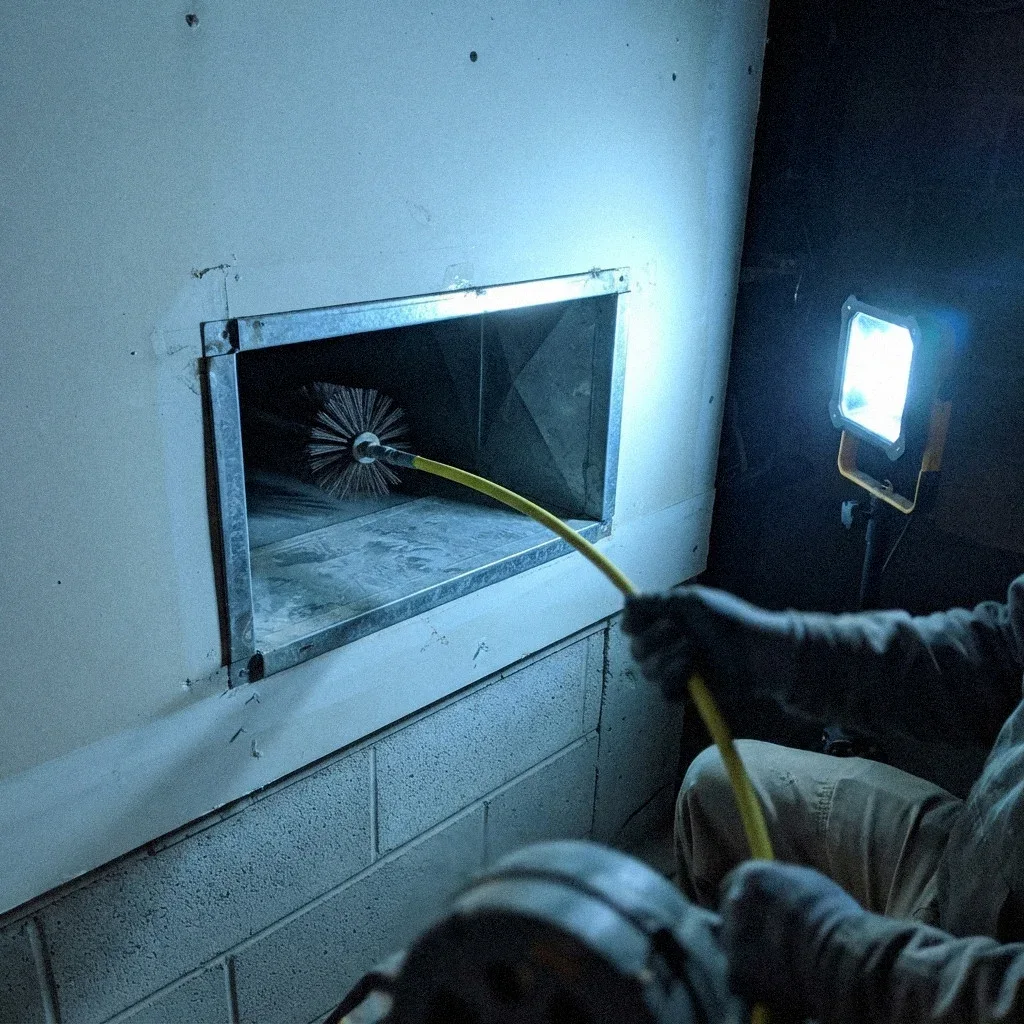
Mold in San Diego Air Conditioning and Ductwork
The cooling system moves air through every room, so growth inside it does not stay in one place.
An air conditioning system spreads mold when the coil, drain pan, or condensate line stays wet and the blower pushes air past that growth into every duct it feeds. Confirm growth by inspection or a swab, not by smell alone, before cleaning coil, pan, line, or ducting, and before replacing ducting that cannot be cleaned.
Why the Coil Grows Mold First
An air conditioning system moves a large volume of air through the house, and in San Diego that air is often carrying marine humidity even on a day with no rain at all. When that humid air crosses a cooling coil running well below room temperature, water condenses out of it, the same way it beads on a cold glass in Pacific Beach on a summer evening. That condensate is supposed to drain away. When it does not, or when the coil itself stays damp between cycles, the system has the two things mold needs: moisture and a surface, running for hours a day, every day the system is used.
The reason cooling system mold matters more than mold almost anywhere else in a San Diego house is distribution. A patch of growth on a bathroom ceiling in Golden Hill stays in that bathroom. A patch of growth on a cooling coil gets a fan behind it, and every time the system runs, air passes over that surface and carries spores into the ducting and out through every register in the house, from a bedroom in North Park to a home office in Kensington. It is the one location built to spread rather than stay put.
None of this requires the system to be old or badly installed. A unit serving a well-kept house in Del Cerro or a rental near San Diego State University can grow the same coil film as one that has been neglected for years, because the mechanism is temperature and moisture, not maintenance history by itself. Poor drainage, low airflow, or a filter that has not been changed will accelerate it, but the underlying condition, condensation on a cold coil, is present in nearly every cooling system in this climate whether or not it ever causes a problem.
The Drain Pan and Condensate Line
The evaporator coil sits inside the air handler and is the coldest surface in the system, which makes it the surface most likely to hold condensation between cooling cycles rather than drying fully. A thin film across the fins looks different from the loose black growth people picture, often gray or white and easy to miss with a flashlight glance. Musty air right after the system kicks on, more than a constant smell, is the more reliable clue, because it suggests something on the airstream itself rather than a static source somewhere else in the house.
Below the coil, the drain pan collects the condensate before it leaves through the condensate line, and both are common places for standing water to sit rather than drain. A pan that holds even a shallow puddle for days at a time in a Clairemont or Bay Park attic closet is functioning as a small reservoir, and a clogged or poorly sloped drain line is usually why. Algae and mold film inside that pan are common and are treated as routine servicing, not as evidence the whole system needs replacing.
- The evaporator coil runs cold and wet for as long as the system cools, which makes it the first surface where marine humidity condenses inside the cabinet, ahead of anything a homeowner in Clairemont or Serra Mesa would notice from a room.
- The drain pan sits under the coil to catch that condensate, and it stays damp between cycles even in a well-running system, which is normal, but a pan that never fully dries between cycles is a different and worse condition.
- The condensate line carries water away from the pan to a drain or outside the house, and a partial clog slows that flow without stopping it, so the pan backs up gradually rather than all at once.
- A fully clogged line backs water up into the pan until it overflows the cabinet, which is usually the point a Linda Vista or College Area homeowner notices a stain on the ceiling below an attic unit.
- Supply ducting carries cooled air from the unit into every room the system serves, so growth at the coil or in the first section of duct rides that airflow into bedrooms and living spaces rather than staying near the unit.
- Return ducting pulls room air back to the unit, and a return that runs through an unconditioned attic or crawl space in an older Talmadge or North Park house can sweat on the outside, wetting insulation from the exterior.
How Growth Spreads Through Ductwork
Growth in the ducting itself is confirmed rather than assumed, because ducting is the part of the system furthest from view and the easiest to guess wrong about. That means opening an access point or removing a section of flexible duct to look directly at the interior surface, not judging by smell alone or by what shows up on the outside of a metal duct running through a crawl space in an older Normal Heights or University Heights house. A visual check inside the duct, sometimes with a borescope for runs that are hard to reach, is what separates a documented problem from a guess.
Testing air samples from supply registers is occasionally used to support a decision, but it is not the default step, and a lab report from ductwork carries the same limits as any other mold test: it can confirm elevated spore counts are present, it cannot name a species from a visual inspection, and no number on that report tells anyone a safe exposure limit, because no such limit exists. For most homes, a direct look inside the duct and coil answers the question a lab report is being asked to answer indirectly.
- A visual check with a flashlight and, where the duct run allows it, a small inspection camera at the coil, pan, and first few feet of supply and return duct, looking for discoloration or a biofilm sheen rather than assuming from smell.
- A swab or tape sample from a suspect surface, sent to a lab, used to confirm growth is present when a visual read is ambiguous, not as a routine step on every service call.
- A check of the drain pan and condensate line for standing water or a slow drain, since a pan that stays wet between cycles is the condition most likely to be growing something even before a sample confirms it.
- A look at duct material and condition, because a metal duct with surface growth is handled differently than a flex duct or duct board section where growth has worked into the material itself.
Cooling System Parts at a Glance
Cleaning a coil generally means removing the access panel and treating the fins directly rather than spraying a general disinfectant through the supply air, since a fogged treatment reaches the ducting unevenly and does nothing for a growth problem sitting on the coil itself. The drain pan gets cleared and, where it holds water because of pitch or a cracked seam rather than a temporary clog, may need attention beyond a simple flush. The condensate line gets cleared of the buildup that caused the standing water in the first place, since clearing the line without fixing drainage brings the same problem back within a season.
Duct cleaning, where it is warranted, means physically dislodging and removing material from the interior surface of the duct runs rather than treating the visible register covers, which are the easiest part to reach and the least representative of what is inside. This is not a service that belongs in every home with central air. A system with a clean coil, a dry pan and no confirmed growth in the ducting has nothing in the airstream to remove, and running duct cleaning on it does not improve air quality that was never compromised in the first place.
| Component | What Grows There | How It's Handled |
|---|---|---|
| Evaporator coil | Constant condensation, dust film | Coil cleaning by a technician |
| Drain pan | Standing condensate water | Pan cleaning, check for cracks |
| Condensate line | Slow drainage, algae buildup | Line flush or clearing |
| Sheet metal ductwork | Condensation on cool metal surface | Wipe cleaning, sanitizing agent |
| Flexible or lined ductwork | Porous inner surface holds spores | Section replacement, not cleaning |
Confirming Growth Before Cleaning
Ducting gets replaced rather than cleaned when the material itself is compromised, most often flexible duct with an inner liner that has absorbed moisture and cannot be scrubbed clean, or metal duct with insulation on the exterior that has gotten wet and stayed wet long enough to support growth in the insulation layer rather than just on the metal surface. A duct that has been sitting damp in a crawl space under a Serra Mesa or Allied Gardens house for an extended period is a more likely candidate for replacement than one that took on brief condensation and dried.
The decision generally comes down to whether the material can be returned to a clean interior surface without leaving residue behind in a porous liner. Rigid metal duct with a hard interior surface can often be cleaned and reused. Flexible duct with fibrous insulation built into the wall of the duct itself is a different case, because the growth is not confined to the surface being wiped. A contractor making this call should be able to show the affected section rather than simply state that it needs replacing.
Cleaning Versus Replacing Ducting
Bleach is sometimes reached for on coil fins or inside a duct because it is the familiar answer to a stain, but it treats the color of the growth and not the growth itself, and it does nothing for the moisture that let it establish there in the first place. A coil that gets wiped down without correcting a drainage problem, or a duct section treated without fixing the leak or condensation source behind it, will show the same film again once conditions return, whether that takes weeks in a humid stretch near the coast in Ocean Beach or longer inland toward Mira Mesa.
The health associations tied to mold exposure are respiratory and allergic, things like asthma symptoms and irritation, worse for people already sensitized, and a cooling system that is actively distributing spores through every room is a reasonable thing to want addressed regardless of how minor those symptoms feel. But that is a different claim from saying duct cleaning improves health in a home where no growth has been confirmed. In a house with no smell, no visible growth and no history of standing water in the pan, there is no established benefit to cleaning ducting that was never a problem.
What Confirms Growth In The System
- A moldy smell from vents does not confirm growth inside the ductwork. It often means the coil or drain pan is wet, or that the ducting is only carrying odor from a bathroom or attic. A visual check of the coil and pan settles it before anyone opens the ducts.
- Color does not identify a species and species is not the deciding factor in remediation; how much material is affected and where it sits in the airflow matter more than what color it is.
- Bleach applied to a coil or duct surface can lighten the color without killing the growth at the root, and it does nothing for the porous material inside a flex duct, which is why cleaning protocol and a wipe-down are not the same thing.
- IICRC S520 is the voluntary industry standard the licensed pros this site connects readers to generally follow for mold work; it is not a law and not specific to HVAC systems, but its containment and cleaning principles apply to coil and duct work.
- A bathroom or attic fan that vents into the roof space instead of outside adds moisture load to the same attic a return duct runs through, which is a separate problem from the AC system but often found during the same inspection.
- Marine humidity meeting a cold coil or a cold duct surface is the mechanism in this climate, not rainfall, so a San Diego house can grow coil or duct mold through a dry summer with no storm and no rain event involved at all.
Frequently Asked Questions
Can mold in my AC make me sick?
Not necessarily. A musty smell when the system starts is common with coil condensation and is usually fixed by cleaning the coil and correcting drainage, not by replacing ducting. Replacement becomes the conversation only when a section of duct, often flexible duct with a wet inner liner, cannot be returned to a clean surface. A direct look inside the affected run, in a Tierrasanta or Mission Valley house or anywhere else, should come before any decision about replacing rather than cleaning.
Do I need to replace the whole duct system?
A window unit or split system coil that runs constantly in San Diego's marine humidity stays wet on the fin side even without a leak. If the drain pan or condensate line backs up, that water sits against the cabinet and the duct boot instead of leaving the house, which is where growth usually starts, not the refrigerant itself.
Why does my AC smell musty when it starts?
Growth is confirmed with a direct look at the coil, drain pan, and the first few feet of duct with an inspection camera or by removing an access panel, sometimes backed by a swab sample. A musty smell from the vents in a Clairemont or Mission Valley house is a reason to look, not a diagnosis on its own.
Is duct cleaning worth it if I have no mold?
Coil and drain pan cleaning removes the growth and the biofilm that feeds it, using tools built for that surface rather than a household spray. Ducting is a different question: sheet metal is generally cleanable, while porous flex duct or duct liner with growth through the material is more often replaced than scrubbed clean.
How do I know if it's the coil or the ducts?
No. Cleaning a duct system that has no confirmed mold and no odor or moisture complaint has not been shown to improve health in an otherwise dry home. The cases worth acting on in a Kearny Mesa or Bay Park house are the ones with visible growth, a wet coil, or a standing complaint, not routine duct cleaning on a schedule.
Have Questions About Your Ducts?
Suspect the coil or the ducting rather than the room air. The licensed pros we connect you with can confirm it. Call (619) 833-1053.
Call (619) 833-1053