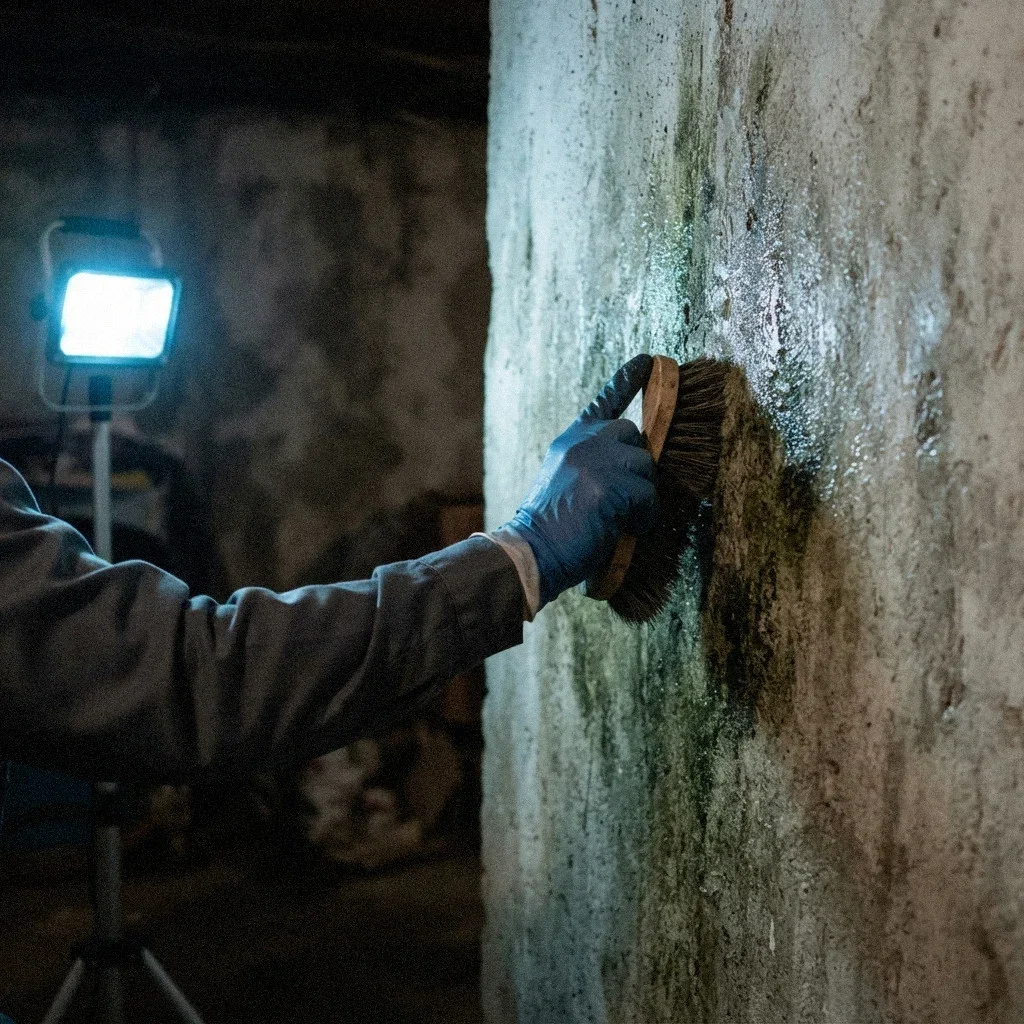
Why Mold Grows Faster in CA Homes
Marine humidity, not rainfall, is why San Diego homes grow mold on a dry-climate schedule most guides miss.
San Diego's marine layer keeps relative humidity high most mornings, even without rain. That steady moisture, not storms, is what feeds mold on single-glazed windows, unvented bathrooms, and AC coils across the city's older housing stock.
Humidity Without the Rain
San Diego does not get the seasonal mold calendar most advice assumes. There is no autumn spike tied to falling leaves and rain, because the city gets nine to ten inches of rain a year, mostly bunched into winter. The driver here is marine humidity, not precipitation. Air rolling off the Pacific Ocean carries relative humidity that stays high for months at a time whether or not a drop falls, and that alone is enough to push organic material in a house past the point where mold can colonize it.
Between May and August, San Diego gets marine layer cloud most mornings, known locally as May Gray and June Gloom. Cool, foggy air sits over the coast until the sun burns it off, often not until midday. That daily cycle matters more to mold than any storm would. Cool, moist air holds less water vapor than warm air, so as morning air warms indoors, relative humidity spikes against cool surfaces before it drops. Understanding that swing explains why growth appears without any leak at all.
San Diego's marine layer keeps mornings cool and damp for months at a stretch, and that pattern matters more to mold than any single storm does. Relative humidity near the coast can sit high before the sun burns the cloud off, and a building does not need rain to stay wet inside. A closed bathroom, a shaded exterior wall, or a room that never gets cross ventilation holds onto that moisture long after the fog has cleared over Mission Bay or Sunset Cliffs.
What the Marine Layer Does
The mechanism is vapor pressure and temperature working against each other. Warm indoor air holds more moisture than cool air can, so when that air contacts a cold surface, the surface temperature drops the air below its dew point and water condenses out. In coastal San Diego neighborhoods like Ocean Beach, Pacific Beach, and La Jolla, indoor air is already loaded with marine moisture most of the year, so the threshold for condensation on a cold surface gets crossed far more easily than in a drier inland climate.
Spores are present in outdoor and indoor air essentially everywhere, all the time. They do not need to be introduced by a leak or a flood. What determines whether they colonize a surface is moisture, not the presence of spores, and not the organic material they land on, since houses are full of paper, wood, and dust that can feed growth once conditions allow it. Moisture is the limiting factor. Remove the water source and the same spores that were always there stop being a problem.
- Marine layer cloud settles over the coast most mornings from May into August, raising relative humidity indoors before the sun burns it off. Homes near Ocean Beach and Pacific Beach feel this first, but the moisture pushes inland along Friars Road and beyond.
- Vapor pressure keeps pushing moisture toward cooler surfaces even on a clear afternoon. A wall facing the bay in Point Loma or a shaded room in Bay Park holds enough of a temperature gap to condense water nobody sees arrive.
- Winter brings the rain, but it is light and short-lived. The humidity that matters here is the daily coastal pattern, not a wet season. A home in La Jolla can grow mold in July with no rain in the forecast.
- Inland neighborhoods like Mira Mesa and Rancho Bernardo see less marine layer, but summer AC use rises, and a stalled condensate line does the same job the fog does closer to the coast.
- Older housing stock across San Diego, from Normal Heights to Golden Hill, was built for a dry climate and rarely accounts for daily condensation cycles. Ventilation was never the priority the design assumed.
- The result is a climate where mold risk tracks humidity and airflow far more than rainfall. National advice built around storms and freezes does not describe what is actually happening on a foggy morning in Bankers Hill.
Older Homes, Fewer Defenses
San Diego housing stock built from the 1940s through the 1970s, common across neighborhoods like North Park, Normal Heights, and City Heights, still runs heavily on single-glazed aluminum windows. Aluminum conducts heat efficiently, which means the frame and glass drop close to outdoor temperature on a cool marine-layer morning. Indoor humidity condenses on that cold surface first, before it touches drywall or wood. That is why growth so often starts right at the window sill and the surrounding frame rather than anywhere near a plumbing fixture.
Older housing across North Park, Kensington, and Talmadge often carries single-glazed aluminum windows original to their build. These run cool relative to indoor air on a foggy morning, so the glass and sill drop below the dew point before the rest of the room does. Condensation collects there first, soaks into the surrounding drywall and curtain track, and gives spores an organic surface to settle on. No leak is required for that cycle to repeat every morning the marine layer holds.
- Bathrooms without an extractor fan, common in houses built before the 1980s, trap shower humidity against tile grout and drywall. Rooms in University Heights and South Park with this gap show microbial growth on the ceiling first.
- An HVAC coil that stays wet from a blocked condensate line pushes moisture into the air handler cabinet and the wall cavity behind it. This shows up in homes across Clairemont and Serra Mesa with older cooling systems.
- Single-glazed aluminum window frames in Talmadge and Kensington sweat on cool mornings. The organic material in the surrounding drywall and paint gives spores a surface to settle on once condensation becomes routine.
- Closets and north-facing walls with poor air circulation hold higher relative humidity than the rest of the house. In Linda Vista and Bay Ho, this is where a musty smell often shows up before any visible patch.
Where Condensation Forms First
Bathrooms are the other predictable spot, and the reason is usually mechanical rather than chemical. A large share of older San Diego houses either have no bathroom extractor fan at all or have one that vents into the attic space instead of outside through the roof or wall. Every shower pushes humid air into that void, and the moisture has nowhere to go. It settles on the underside of the roof sheathing and the attic-facing side of the bathroom ceiling, which is exactly where homeowners in houses across San Carlos, Del Cerro, and Allied Gardens find dark patches they cannot explain from inside the room.
A fan that vents into the attic will pass every inspection that only checks whether the fan turns on, because the switch works and air moves. What it does not do is remove moisture from the building, which is the fan's actual job. Humidity control depends on getting that air outside, not just off the ceiling. Where the vent duct has come loose or was never connected to a roof cap in the first place, the fan is functionally decorative, and the attic keeps absorbing bathroom humidity year after year without anyone noticing until the ceiling stains through.
| Surface | Why It Condenses | Common Fix |
|---|---|---|
| Single-glazed aluminum window | Cool marine mornings, May through August | Sill, frame, nearby drywall |
| Bathroom without exterior vent fan | Every shower, year-round | Ceiling, grout, exhaust duct |
| AC air handler and coil | Blocked condensate line, warm months | Drain pan, cabinet, ceiling below |
| Crawl space framing | Ground moisture, poor airflow | Subfloor, joists, insulation |
| Closet against exterior wall | Trapped humid air, little circulation | Baseboard, wall corner, stored fabric |
Moisture Is the Only Limit
Air conditioning changes the picture but does not remove it. Where a house has central air, common in inland neighborhoods like Mira Mesa, Rancho Bernardo, and Scripps Ranch, the AC coil is constantly pulling moisture out of indoor air and dropping it into a condensate line. If that line clogs, which happens gradually as biofilm and dust accumulate inside it, water backs up into the air handler cabinet and drips into the drain pan, the surrounding cabinet insulation, or the ceiling below a closet-mounted unit. That failure produces some of the most contained but persistent microbial growth in the trade, tucked out of sight in a mechanical closet.
Coastal neighborhoods often skip air conditioning altogether, since marine layer mornings keep summer temperatures mild enough that many older homes in areas like Ocean Beach or Point Loma were never built with it. That trades one risk for another. Without an AC coil running, there is no passive dehumidification happening anywhere in the house, so whatever humidity the marine air brings in stays at whatever level the outdoor air sets. A house that feels comfortable without air conditioning can still be sitting at a relative humidity high enough to support growth on the right surface.
Reading the Warning Signs Early
No amount of ventilation or air handler maintenance guarantees a mold-free house, and no health agency publishes a threshold below which spore exposure is considered fine. That is a different claim from saying every case is serious. Most of what grows on a bathroom ceiling or a closet wall in Clairemont or Linda Vista is a moisture problem with a visible symptom, and the fix is finding where the water or vapor is coming from, not identifying which organism showed up first.
For most visible mold, testing adds a lab report without adding a next step, since the plan is the same regardless of species: find where the water is coming from, dry the material or replace it, and remove the growth. Testing earns its cost in narrower situations, like confirming air quality after remediation or investigating a smell with no visible growth. Framing it that way keeps the focus where it belongs, on the moisture source behind a window, a bathroom ceiling, or an air handler, rather than on a report that describes a problem without solving it.
What Actually Feeds Growth Indoors
- No safe exposure limit for indoor mold has been established. Guidance focuses on removing growth and fixing the moisture source rather than measuring spore counts against a threshold.
- Color does not identify a species. Black, green, and white growth can all come from the same handful of common indoor molds depending on the surface and the moisture level.
- Bleach changes the color of a stain but does not reliably stop growth on porous material. It off-gases strongly and treats the surface, not the moisture feeding what is underneath.
- Moisture, not the presence of organic material, is what limits mold growth in a building. Wood, drywall, and dust are already there; water is the variable that decides whether colonization happens.
- Testing is usually unnecessary when growth is visible. A lab report earns its cost when the growth is hidden behind a wall or when a dispute needs documentation.
- San Diego's marine layer, not its rainfall, is the main humidity driver behind indoor mold. Fog and cloud between May and August raise relative humidity even on days with no measurable precipitation.
Frequently Asked Questions
Why does my house get moldy without any rain?
No. San Diego's mold pattern tracks marine humidity, not rainfall, so growth shows up in the dry months just as often as after winter rain. Condensation on aluminum-framed windows, bathroom fans venting into an attic, and clogged AC condensate lines all operate independently of whether it has rained recently. A dry stretch does not mean the moisture source causing a stain has gone away.
Which rooms in my house get mold first?
No. San Diego averages under ten inches of rain a year, yet mold complaints stay steady through the marine layer months of May through August. Humidity from the coast, not precipitation, is the moisture source driving growth in homes near Ocean Beach, Pacific Beach, and beyond.
Does San Diego's weather really cause mold?
Cool nights push warm indoor air against cold glass, and single-glazed aluminum windows common in Clairemont, City Heights, and North Park hold no thermal break. Water beads on the sill, soaks the drywall edge, and colonization starts there before anywhere near a plumbing leak.
Why is mold worse on my windowsills?
Not on its own. Color reflects the surface and the substrate more than the organism underneath. A lab report and a visual inspection tell you more about the moisture source and how far it has traveled than the shade of the growth ever will.
Do older San Diego homes get more mold?
Usually not. Testing adds cost without changing the fix: visible growth gets removed and the moisture source gets corrected. Testing earns its place when growth is hidden, when air quality is disputed, or after remediation to confirm the work in a home in Kensington or Talmadge held.
Wondering What's Growing in Your Home?
Curious whether a smell or a stain in your San Diego home is a moisture problem worth checking? Call (619) 833-1053 to ask a licensed pro.
Call (619) 833-1053