Attic Mold: Why It Starts and What It Takes to Clear in San Diego, CA
Warm, damp house air meets cold roof sheathing in the attic, and that is where the mold starts.
Attic mold comes from warm, moist house air reaching cold roof sheathing and condensing. The usual causes: a bathroom or dryer fan venting into the attic, blocked soffit vents, missing baffles, or insulation covering the vents rather than clean roof-to-attic airflow.
How Warm Air Finds Cold Wood
An attic in San Diego grows mold on the same principle as a cold drink sweating on a warm day. Warm, moist air from inside the house rises and reaches the cold underside of the roof sheathing, especially overnight and in the marine layer months when outside air is already carrying moisture. The air cools against the wood, gives up water it can no longer hold, and that water sits on the sheathing and framing. Nothing about this needs rain. It needs warm indoor air meeting a cold surface, which a San Diego attic supplies most of the year.
The house does not need a storm to feed that air. Cooking, showers, breathing, and a laundry load all put water vapor into the house, and that vapor looks for the coldest, driest path out. If the attic is colder than the living space below it, and there is any gap for air to travel through, some of that moisture ends up in the roof space rather than outdoors. Over a season it does not take a leak or a flood, just an ordinary house doing what houses do, night after night.
What separates an attic that stays dry from one that grows mold is usually not the amount of moisture produced but where it is allowed to go afterward. A house with a working path to the outside for that damp air rarely has a problem. A house without one accumulates it, attic after attic, in older neighborhoods across San Diego from Clairemont to Allied Gardens to Serra Mesa, regardless of how far any of them sit from the coast.
Where the Moisture Enters
The most common fault is a bathroom fan or dryer duct that terminates under the roof deck rather than through it. Every shower in a San Diego home pushes warm, wet air upward, and if that duct stops short, the moisture never leaves the house. It settles on the nearest cold surface, which is the underside of the sheathing, night after night. A fan that runs but never actually exhausts outside is worse than no fan at all, since it gives the illusion the moisture problem is handled.
The second fault is soffit vents that are blocked, painted shut, or were never cut through the plywood behind the vent covers when the house was built. Soffit vents are meant to pull in outside air at the eaves so it can push warm attic air out near the ridge. A vent that looks fine from the driveway but was never opened behind the screen does nothing, and a house can carry that defect for decades without anyone noticing until the sheathing above it starts showing dark staining.
- A bathroom fan ducted a few feet into the attic instead of through the roof or a gable wall. Steam collects on the underside of the sheathing every time the shower runs, and nobody sees it because the duct end is buried in insulation.
- A dryer vent that was never connected to anything outside, so lint and warm moist air empty directly under the roof deck. This is a fire hazard as well as a moisture one, and it shows up often in houses built before venting rules were routine.
- Soffit vents painted over, screened shut, or never cut through the sheathing when the eave was built. Outside air cannot get in, so the attic has no way to flush out the moisture that reaches it from below.
- No baffles at the eaves, so loose insulation has drifted over the soffit openings from the inside. The vents look fine from the ground but are blocked where it matters, a few inches inside the roofline.
- A ridge vent or roof louvers with no matching intake at the soffits, so the attic has an exit for air but no entrance. Warm air stalls instead of moving through, and condensation forms wherever the roof deck is coldest.
- Recessed light fixtures cut into a ceiling below the attic without an airtight housing. Warm, humid room air leaks straight up through the gaps around the fixture and condenses on the first cold surface it reaches.
What the Growth Looks Like
The third fault is missing baffles, the simple channels that hold insulation back from the soffit vents so air can still travel up from the eaves. Without a baffle, loose insulation drifts or gets blown right up against the vent opening and seals it from the inside. The vent is unobstructed on the outside and useless on the inside. This is a common finding in San Diego attics that have had insulation topped up over the years without anyone checking what happened to the airflow underneath it.
The fourth fault is insulation itself covering the vents, usually from a retrofit job that added depth without protecting the original venting. It is easy to see why: more insulation reads as an upgrade, and nobody climbing into an attic to blow in insulation is thinking about whether it will bury the soffit line. The result is an attic that is better insulated and worse ventilated at the same time, which for moisture purposes can be a net loss rather than a gain.
- Wet or moldy insulation is checked first, because fiberglass and cellulose hold water rather than shedding it and keep feeding moisture to the wood even after the leak or the vent problem is fixed.
- Insulation that has absorbed water is typically removed rather than dried in place, since it has lost most of its performance anyway and stays a moisture reservoir against the sheathing until it is pulled.
- The roof deck and rafters underneath are cleaned once the insulation is out of the way, because that surface is where spores actually took hold and it cannot be reached with insulation sitting against it.
- Fresh insulation only goes back in after the vent path is corrected, whether that means rerouting a fan duct outside, clearing soffit vents, or adding baffles, otherwise the same failure just repeats under new insulation.
The Four Usual Faults
Clearing an attic starts with finding which of these faults, or which combination, is actually present, because treating the mold without fixing the airflow just buys a repeat visit next year. That means tracing every duct that enters the attic back to where it actually terminates, checking soffit vents from inside as well as outside, and looking at whether baffles exist at all before assuming they are just blocked. A ridge vent or roof vent with no matching intake at the soffits is also common and is its own version of the same problem.
Once the fault is identified, the growth on the wood itself gets addressed directly: moldy material removed or cleaned depending on how deep it has gone, surfaces treated, and the space dried out completely before anything is closed back up. None of that holds if the moisture keeps arriving. A remediation that skips the duct or the vent and goes straight to cleaning the wood is treating the stain and leaving the cause exactly where it was.
| Fault | What It Does | Fix |
|---|---|---|
| Misrouted extractor fan | Bathroom or dryer vents into attic | Reroute duct through roof or wall |
| Blocked soffit vents | Paint or debris seals intake air | Clear or replace vent screens |
| Missing baffles | Insulation blocks soffit-to-ridge airflow | Install baffles at eave line |
| Buried vents | Insulation piled over vent openings | Pull back insulation, reopen path |
| No ridge or roof vents | Warm air has no exit at the peak | Add ridge, roof, or gable vents |
Why Insulation Usually Comes Out
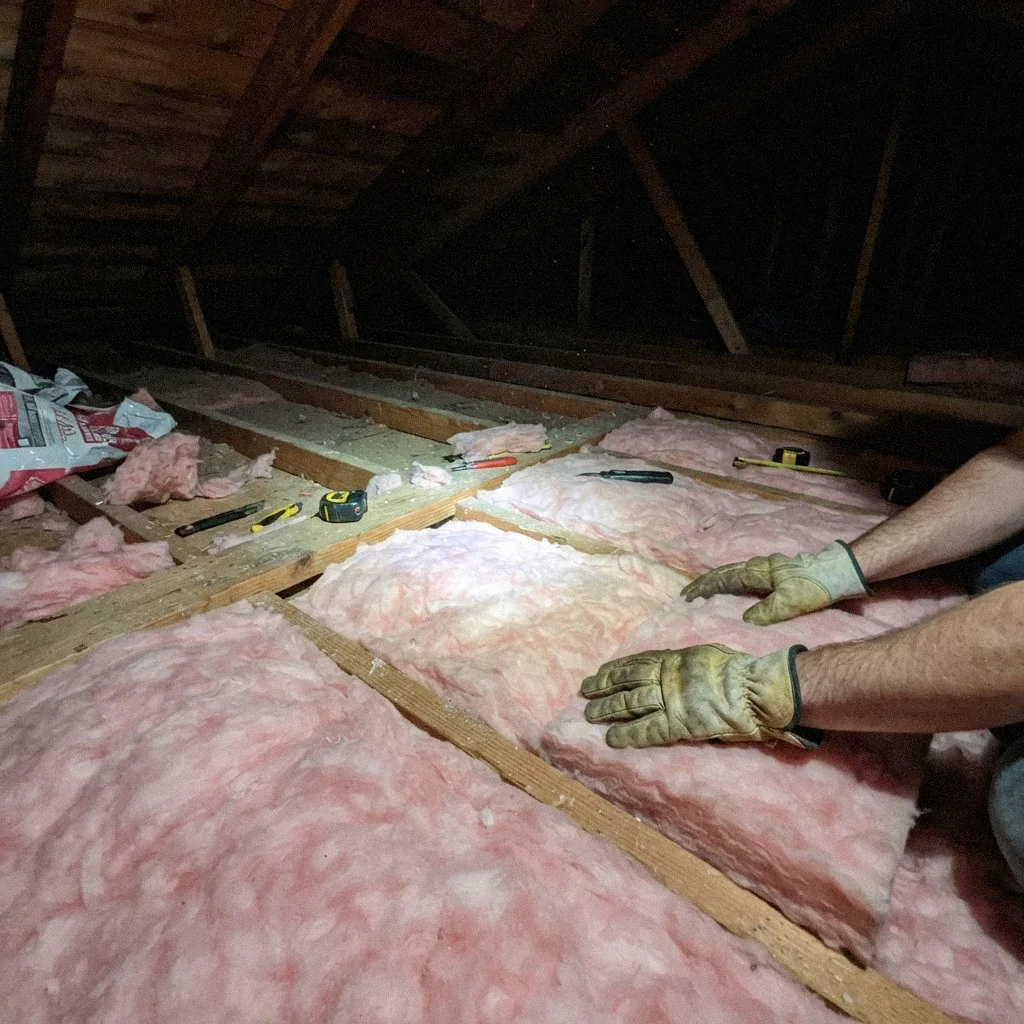
Insulation usually has to come out, and this surprises people who assume it can just be cleaned or left in place. Fiberglass batts and loose-fill insulation are not solid surfaces; they trap spores and moisture inside their structure in a way that wiping a rafter does not. Insulation that has been sitting damp against moldy sheathing has usually absorbed enough of both that removing it is faster and more reliable than trying to treat it in place, and it also clears the way to actually see and fix the sheathing underneath.
Removing the insulation also solves a second problem: it is the only way to properly inspect the soffit vents and baffles that started the whole thing. An attic with the insulation pulled back is an attic where a duct can be traced, a blocked vent can be spotted, and a missing baffle is obvious rather than buried under twelve inches of fill. New insulation goes back in only after the moisture source is fixed and the space has dried, never before.
What Clearing an Attic Involves
A homeowner does not need to identify which of the four faults is present before calling someone. What is useful to know going in is that a fan duct dumping into the attic, a sealed soffit vent, a missing baffle, and insulation piled against a vent all produce the same visible result on the sheathing, so the diagnosis has to happen before the fix, not after. Anyone who proposes cleaning the attic without first tracing every duct and checking every vent is only doing half the job.
This is also why no two attic jobs in San Diego look quite the same, even in similar houses a few blocks apart in North Park or Talmadge. One might have a dryer duct venting straight into the roof space, another might have soffits that were sealed during a stucco job decades ago, and a third might simply have too much insulation blocking air that used to move freely. The mechanism is identical. The fault behind it is specific to that house.
Four Faults Behind Most Attics
- Attic condensation happens without a roof leak. Warm, moist air from the rooms below is often the entire cause, which is why an attic can grow mold in a house that has never had rain get in.
- Color does not identify what is growing. Black, green, and white growth all need the same fix: find where the moisture is reaching the wood and stop it, then clean the surface.
- Contractors doing this work in San Diego carry a Contractors State License Board classification rather than a mold-specific credential, because the state stopped short of licensing mold remediators the way some other states do. Ask which classification the pros you're calling hold before they're on the roof.
- There is no legal exposure limit for indoor mold in California. No inspection can tell a homeowner their attic air meets a standard, because no numeric standard was ever set.
- Testing an attic for mold is usually unnecessary once growth is visible on the sheathing or rafters. The identity of the species rarely changes what work needs to happen next.
- San Diego's marine humidity means attics see moisture year round, not just after a storm. The city's dry rainfall total has little to do with how often attics condense.
Frequently Asked Questions
Why does my attic have mold if it never rains?
No. Once mold is visible on sheathing or insulation, the growth itself has to be physically removed or cleaned; color changing or fading is not the same as the growth being gone. Bleach also does not reach spores inside porous material like insulation or raw wood, so a bleached rafter can still carry active growth underneath a lighter-looking surface. The airflow fault also still needs fixing regardless of what touches the wood.
Do I need to replace the attic insulation?
Usually not, and that is the point of fixing the vent path rather than just the fan. If a bathroom fan or dryer duct dumps warm air under the roof deck near San Diego, humidity climbs every time it runs. Reroute the duct through the roof or a gable louver, confirm soffit intake is clear, and the sheathing dries between uses instead of collecting new moisture each week.
Is a moldy attic a health risk for my family?
Soffit vents pull outside air in at the eaves and a ridge or roof vent lets warm air out at the top. If soffit vents are painted shut, blocked by insulation, or were never cut through the sheathing, the attic cannot exchange air and moisture has nowhere to go but onto the wood.
Can I just bleach the rafters myself?
Baffles are the channels that keep insulation from blocking soffit vents. Without them, blown-in or batt insulation drifts against the eaves and seals off the intake air the attic needs. A house can have working vents cut into the soffit and still suffocate if nothing holds the insulation back.
How do I know if my bathroom fan is the cause?
Usually, if it has absorbed moisture. Fiberglass and cellulose hold water against the sheathing rather than shedding it, which keeps wood damp long after the source is fixed. Pulling wet insulation and correcting the vent path first is what stops the attic from regrowing mold once it is cleaned.
Wondering What's Under Your Insulation?
An attic with no baffles or a fan venting into the roof space keeps producing mold after cleaning. Call (619) 833-1053 to get the venting fixed first.
Call (619) 833-1053