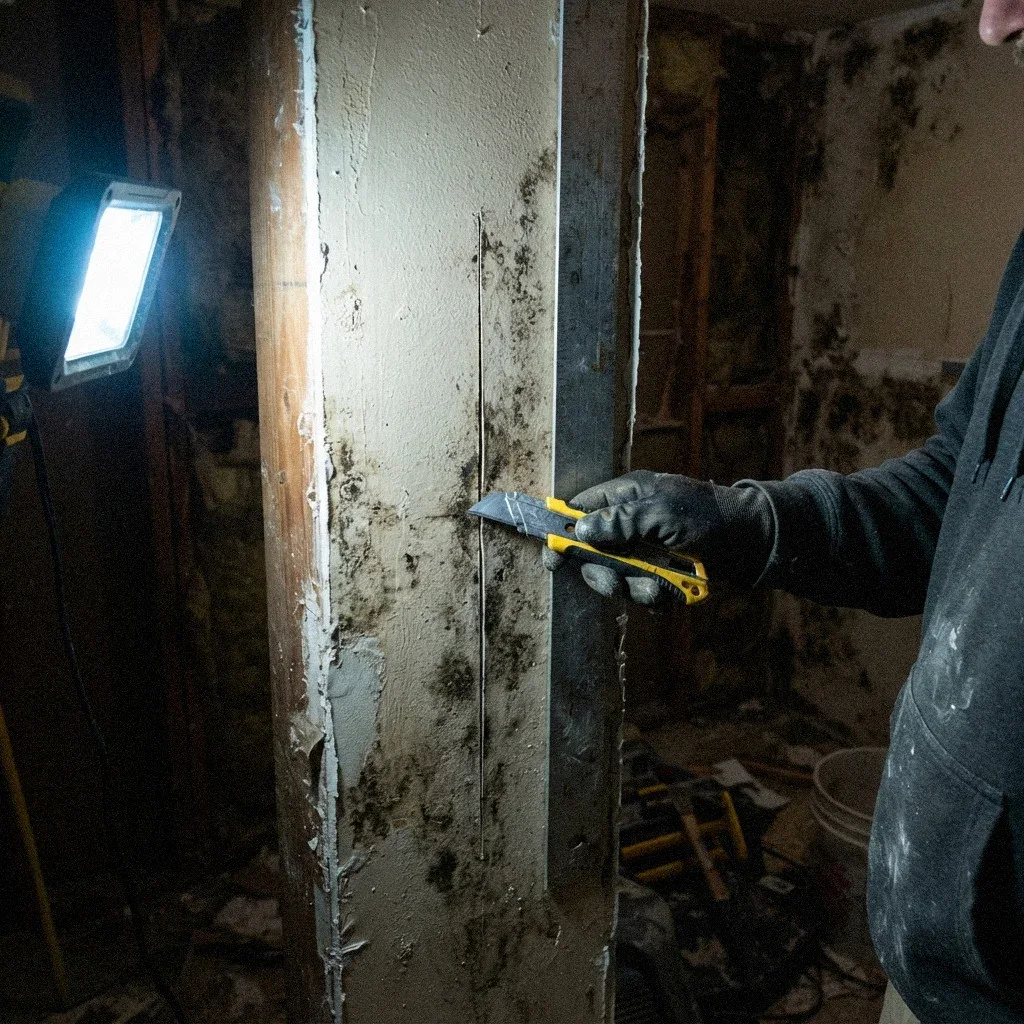
Buying or Selling a Home With Mold in CA
What a mold inspection means for a San Diego sale, and what a buyer should ask the seller to fix first.
A mold inspection or remediation record surfaces in a San Diego sale when a report exists, when a seller discloses a past issue, or when a buyer's inspector spots staining. There is no state permissible exposure limit, so no report can call air 'safe' — only visibly clear or not.
Why mold shows up in inspections
A mold inspection during a home sale in San Diego does not test air against a legal limit, because California never set one. What it produces instead is a description: which materials are affected, roughly how far the growth extends, and whether the moisture source has been found. That description is what both sides end up negotiating over, not a pass or fail grade. A buyer in Kensington or North Park should expect a report that names conditions, not one that certifies the house clean.
Visible mold on a bathroom ceiling or along a Clairemont crawl space sill usually settles the question of whether remediation is needed. Testing before that point rarely adds anything, since it identifies spores already known to be there without changing the recommended work. Where testing earns its cost is after remediation, as a clearance check confirming spore counts have returned to a range comparable with outdoor air. That distinction matters in a sale, because a report with no clearance step leaves the buyer guessing whether the job actually worked.
A written inspection report matters more than a verbal reassurance from either side. It should note where growth was found, what moisture reading accompanied it, and whether the source was identified or just the symptom. In Kensington and Talmadge, where many houses still carry original plumbing runs, a damp patch under a sink is often the first visible sign of a slow leak that has been feeding a colony for months before anyone opened the cabinet.
What disclosure duties turn on
Remediation records carry more weight in a negotiation than the mold itself. A folder showing which materials were removed, what moisture source was corrected, and what a follow-up clearance test found tells a buyer in Talmadge or South Park that the problem was addressed, not just covered. Without that folder, a buyer is left to assume the work was cosmetic. Paint over a water stain looks identical to remediation from a listing photo, and only records tell the difference.
Ask for the invoice from the pros who did the work, not just a photo of a clean wall. A useful record names the affected material, whether it was removed or treated, and what moisture source was corrected so the same spot doesn't reappear. A clearance visit after the work, confirming the area reads dry and the growth hasn't returned, tells a buyer more than any before-and-after picture from a listing near Golden Hill or South Park.
- A home inspector who notices a musty smell, staining near a window, or a soft spot in drywall will usually flag it for further evaluation rather than identify a species or quantify a health risk, which is outside a general inspector's scope.
- A specialist assessment, if one follows, typically documents where growth is visible, what moisture source likely caused it, and how far it may extend behind the surface — not a number a buyer can hold up as a pass or fail.
- A clearance result documents conditions on the day of the test, not a guarantee against regrowth. If the moisture source behind a Golden Hill stucco wall or a North Park attic was never fixed, a clean air sample today says little about six months from now.
- A seller in Talmadge or Clairemont who already remediated a past problem should keep the invoice, the scope of work, and any clearance documentation — this paperwork often matters more to a deal than the original inspection did.
- Buyers near Mission Valley or the San Diego River corridor sometimes assume flood history explains staining. In this city the more common cause is a bathroom fan venting into the attic instead of outside, not river proximity.
- An inspection that finds nothing visible does not mean nothing is present. Growth inside a wall cavity near a leaking supply line can sit undetected until a remodel or a later sale opens the wall.
Reading a remediation record
California does not set a legal air quality limit for mold, so no report can say a home passed or failed against a number. Disclosure duty turns on what a seller actually knows, not on hiring someone to go looking, and that knowledge threshold is worth understanding before either side treats a lab result as a verdict. A visible patch behind a Point Loma bathroom mirror, once disclosed, becomes a negotiating point rather than a legal one.
Older housing across neighborhoods like City Heights or Normal Heights often lacks a bathroom extractor fan, or has one that vents into the roof space rather than outside. That single detail explains a disproportionate share of bathroom and attic mold in this climate, and it rarely shows up in a listing disclosure because sellers do not always know to look for it. A buyer walking through an older house can check this in minutes, and a missing or misdirected vent is worth raising before closing rather than after.
- A completed remediation with a clearance visual assessment tells a buyer in Golden Hill or South Park that the growth was addressed and the space looked clear afterward — not that the moisture source causing it was necessarily fixed.
- Ask for the original assessment, the scope of remediation work performed, and any post-remediation clearance documentation. Missing paperwork is common in older sales and is not itself proof anything was hidden.
- A seller in University Heights or Normal Heights disclosing a past leak near El Cajon Boulevard is describing a moisture event, not necessarily an ongoing one — ask what fixed the source, not just what removed the growth.
- Buyers sometimes negotiate a credit instead of requiring pre-close remediation. That shifts the work and the verification to after closing, which suits a buyer confident in a licensed contractor's assessment.
What a buyer should request
A pre-purchase inspection that flags a musty smell without visible growth puts a buyer in a harder spot than one with a clearly documented problem. There is no test that resolves a smell into a certainty, and San Diego's marine humidity means a slightly musty crawl space under a Point Loma or Linda Vista home is not automatically a red flag. What matters is whether the smell traces to standing moisture, a plumbing leak, or condensation, and that requires someone actually looking under the house or behind the fixture, not just noting the odor on a checklist.
Color is not a reliable signal in any of this. A black stain on a ceiling in a Serra Mesa home is not identifiably more dangerous than a white or green one without a lab identifying the species, and even then, species identification changes very little about how remediation is performed. A buyer or seller relying on color to judge severity is reading a signal that was never designed to carry that information, and a report that leans on color language deserves a follow-up question about what it actually measured.
| Document | What It Shows | Why It Matters |
|---|---|---|
| Inspection report | Where mold was found and likely cause | Shows scope, not just presence |
| Remediation scope of work | What was removed and from where | Confirms the fix matched the finding |
| Moisture source repair | Plumbing, roof, or ventilation fix | Without this, mold returns |
| Clearance result | Post-remediation verification | Confirms the work finished, not air quality |
| Seller disclosure statement | Known issues in writing | Sets what was known and when |
What a clearance result actually says
Escrow timelines put pressure on all of this. A remediation job started after an inspection contingency is raised may not have time for a full clearance test before closing, which means the buyer is sometimes asked to accept a contractor's word that the work is finished rather than a lab result confirming it. In a competitive pocket like La Jolla or Pacific Beach, buyers sometimes waive this step to keep a deal moving, which is a real tradeoff worth naming rather than glossing over.
A reasonable middle position is a holdback: funds set aside at closing tied to a clearance test completed within a set window afterward. This keeps the transaction moving without asking either side to simply trust the other. It is a negotiated term, not a standard form, so it has to be written into the purchase agreement specifically rather than assumed. An agent or attorney familiar with local transactions, not a remediation contractor, is who structures this part.
Negotiating around a mold finding
Bleach shows up in a surprising number of pre-listing attempts to handle mold before a sale, and it is worth saying plainly that bleach treats the color, not the growth. It can lighten or remove staining on a nonporous surface while leaving the organism intact underneath, especially on porous material like drywall or wood framing common in houses around Allied Gardens or San Carlos. A buyer who sees a suspiciously clean patch of drywall next to an otherwise dated bathroom has reason to ask what was actually done there.
None of this is about assigning blame so much as getting the paperwork to match the physical reality of the house. A seller in Rancho Bernardo or Scripps Ranch who addresses a moisture source, keeps records of what was removed and why, and gets a clearance comparison after the work is in a strong position either way, because the story holds together. A buyer's real leverage is simply asking for that story before deciding whether the price or the repair credit reflects what actually happened.
What Belongs in the File
- California has no permissible exposure limit for indoor mold, so no report or inspection can state that air in a Bankers Hill or Point Loma home is within a legal safe range.
- Color does not identify a species. A dark stain on drywall in a Serra Mesa or Mira Mesa home tells you growth is present, not what kind or how serious.
- The Toxic Mold Protection Act of 2001 is California's framework for mold. Health and Safety Code section 26148 addresses disclosure to tenants specifically, not general home sale disclosure.
- S520 covers containment, drying verification and clearance testing for a remediation job. It sets a process, not a pass or fail number, since there is no exposure limit a lab result gets measured against.
- California requires no separate mold trade license. The contractor doing the work in a Talmadge or South Park home holds a standard CSLB classification, so ask what that classification is and what it covers before signing anything.
- Testing is usually unnecessary for mold that is already visible. It matters more when growth is suspected but hidden, such as behind a wall near a plumbing line in an older Linda Vista or Bay Park home.
Frequently Asked Questions
Does mold in an inspection kill a home sale?
Ask for the moisture source finding, not just a list of materials removed. A remediation report for a house in North Park or Kensington should say what caused the water or humidity problem, how it was corrected, and whether a clearance sample afterward compared to an outdoor or unaffected baseline. Records showing cause and correction matter more than a single spore count with no context behind it.
Do I have to disclose mold when selling?
Disclosure duties vary and turn on what a seller actually knew and when. A seller aware of a past leak or remediation in a Hillcrest or Talmadge home generally should not conceal it, but the specifics depend on the transaction and are worth reviewing with a real estate professional rather than assuming a rule.
What should a buyer ask for after a mold report?
Not necessarily. A visible mold finding is common in older housing stock and does not automatically kill a deal. What buyers and sellers in areas like Allied Gardens or San Carlos usually negotiate over is who addresses it and whether the moisture source gets fixed, not whether the sale proceeds.
Is a clearance test enough for the lender?
No. A clearance result generally means the treated area looked clear on visual reassessment after remediation. It does not certify the air is free of mold spores, since no permissible exposure limit exists to certify against in the first place.
Who pays for mold removal, buyer or seller?
Ask for the original inspection or assessment, the written scope of remediation performed, invoices, and any post-work clearance documentation. If the moisture source was addressed — a fan vent redirected outside, a roof leak repaired — ask for proof of that fix too, not just the cleanup record.
Ready to Talk Through Your Report?
Get a written clearance report before closing escrow. Call (619) 833-1053 to line up an independent inspection you can hand to the other side.
Call (619) 833-1053