Crawl Space Mold and the Vapor Barrier Underneath in San Diego, CA
Why the space under a raised floor stays damp in San Diego and what a vapor barrier actually changes.
A crawl space stays damp because bare soil releases moisture continuously, with no rain required. A vapor barrier is heavy plastic sheeting laid over that soil to block ground moisture before it reaches floor joists, insulation, and household air.
Why the Crawl Space Stays Damp
Houses in San Diego rarely have basements, but a large share of pre-1950s neighborhoods, including Golden Hill, South Park, and parts of Ocean Beach, sit on a raised floor over open ground. That gap between the joists and the dirt is a crawl space, and it is usually the dampest part of the house. Bare soil releases moisture into the air continuously, whether or not it has rained, because the ground underneath a house holds water long after the surface has dried.
That moisture does not need rain to matter. San Diego's mold problem is driven more by marine humidity than by precipitation, and a crawl space concentrates that humidity because the air down there barely moves and never sees sun. Wood framing, subfloor insulation, and ductwork all sit in contact with that damp air. Given enough time, the moisture content of the wood rises to a point where mold does not need a leak or a flood to get started.
A homeowner in North Park or Talmadge who smells something musty from a floor register is often smelling the crawl space, not the room above it. The air down there gets pulled up through gaps in the subfloor and around plumbing penetrations every time the furnace or air handler runs. The smell is a symptom of the space underneath, and treating the register or the room above it does nothing about where the moisture is coming from.
What Bare Soil Releases
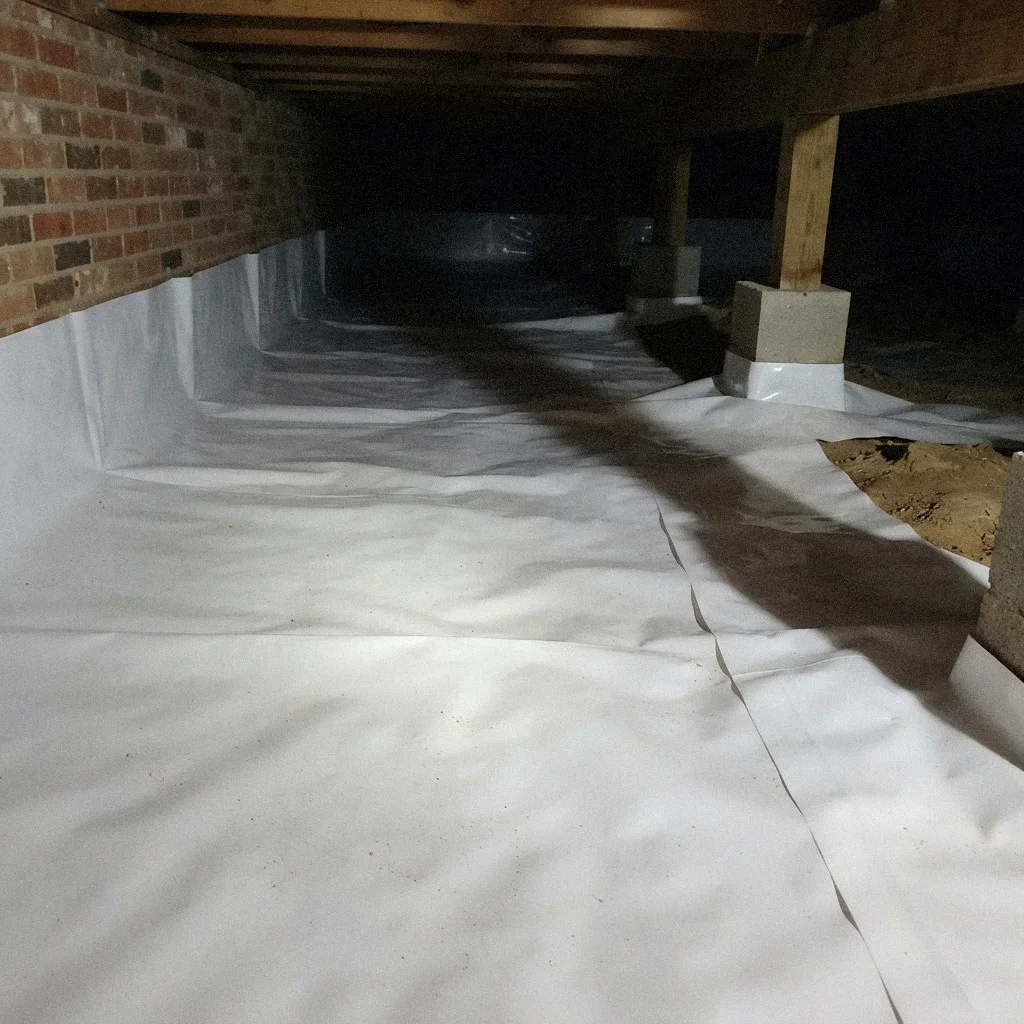
A vapor barrier is a sheet of plastic laid over the bare soil in a crawl space, sealed at the seams and run partway up the foundation wall. Its job is narrow: stop ground moisture from evaporating directly into the crawl space air. It does not dry out wet wood, fix a plumbing leak, or address standing water. It only blocks the one moisture source that is present in every crawl space regardless of the house's condition, which is the soil itself.
Without a vapor barrier, the ground under a house in Kensington or Allied Gardens is effectively an open water source, sitting a few feet below the subfloor, working continuously. Laying six or ten mil plastic over that soil interrupts the cycle at its source rather than treating the symptom in the wood above it. It is a low-cost, largely one-time fix compared to the mold cleanup that repeats if the ground is left exposed.
- Soil under a house is rarely as dry as soil that sees sun and wind. Covered by a floor, it releases water vapor into the crawl space around the clock, in every season, regardless of whether San Diego has seen recent rain.
- Warm days pull that moisture upward. Cooler joists and subfloor above condense some of it back into liquid water, which is why wood framing in an unsealed crawl space can feel damp to the touch even during a dry summer.
- Pre-1950s houses in neighborhoods like Golden Hill and South Park were built with raised floors over open crawl spaces, a common method before slab-on-grade construction became standard, and many still have no ground cover at all.
- Without a barrier, that moisture works its way into insulation, subfloor wood, and any cardboard or fabric stored down there, giving mold a steady supply of the one thing it needs most: sustained dampness.
- Marine air off the Pacific Ocean adds to this. Fog and humid nights push moisture into vents that were meant to dry the space, so the crawl space often stays wetter than the outdoor air suggests.
- None of this depends on a leak or a storm. A crawl space with bare soil and no barrier will generate its own moisture problem over time, which is why it is worth checking even in houses with no known water issue.
Why Venting Can Backfire
It seems logical that adding vents would let a damp crawl space breathe and dry out, and older building codes in places like Normal Heights and University Heights were written around that idea. In San Diego's marine climate, that logic breaks down. The air coming through a vent for much of the year carries more moisture than the crawl space already holds, particularly during the marine layer months when outdoor humidity runs high even without rain.
Venting in that condition pulls humid outside air in, where it contacts the cooler soil and framing and condenses, adding water rather than removing it. This is the opposite of what the vents were meant to do, and it explains why some crawl spaces stay damp no matter how many vents are added or how often they are cleared. The fix is not more airflow. It is cutting off the ground moisture and controlling humidity directly instead.
- Older crawl space designs relied on foundation vents to let humid air escape. In a marine climate, the air coming in through those vents is often more humid than the air already trapped inside.
- Encapsulation means sealing the ground with heavy plastic sheeting, taping the seams, and running it up the foundation walls. Done well it stops soil moisture from ever reaching the framing above, which is the point a bare-soil crawl space usually misses entirely.
- Encapsulation means sealing the ground with a vapor barrier, taping the seams, and often closing or controlling the vents so the space is no longer exchanging air freely with the outside.
- A dehumidifier earns its place once the plastic is down and the space is sealed, not before. Running one over open soil just pulls moisture out of the air while the ground keeps adding more underneath it.
Comparing the Moisture Options
Encapsulation goes further than a vapor barrier alone. It typically means sealing the crawl space more completely: covering the soil, sealing foundation vents rather than relying on them, and often insulating the foundation walls instead of the subfloor above. The goal is to remove the crawl space from the outside humid-air cycle entirely and treat it as part of the conditioned building rather than a vented gap underneath it.
This is a more involved project than laying plastic on the ground, and it is worth doing correctly once rather than partially more than once. A crawl space in a house near Mission Trails Regional Park or Cowles Mountain, where soil and grading vary block to block, may need different detailing at the foundation wall than one closer to the coast. The principle stays the same: seal the ground, seal the vents, and stop treating outside air as the fix.
| Condition | What It Means | What Helps |
|---|---|---|
| Ground cover only | Blocks soil moisture at the surface | Vents and seams stay open |
| Sealed encapsulation | Seals soil, walls, and vents | Usually needs a dehumidifier too |
| Vents left open | Lets outside air exchange freely | Can add humid air in summer |
| Standalone dehumidifier | Pulls moisture from crawl space air | Does nothing about soil moisture |
| Barrier plus dehumidifier | Addresses soil and air moisture together | Most reliable combination for older homes |
What Encapsulation Involves
A dehumidifier belongs in a crawl space when sealing the ground and the vents is not enough on its own, which happens more than homeowners expect. Encapsulation removes the biggest moisture source, but a crawl space can still hold humidity from a slab leak, a plumbing drip, or simply residual dampness in framing that has not fully dried out yet. A dehumidifier sized for the space and left running continuously addresses that remaining moisture directly.
It is not a substitute for the vapor barrier, and running one in a crawl space that still has bare exposed soil is working against a moisture source that never stops. The two measures do different jobs: the barrier blocks moisture at the ground, and the dehumidifier manages whatever moisture is already in the air. A crawl space with both usually holds a stable, dry condition through the year without depending on outside air at all.
When a Dehumidifier Belongs Down There
None of this requires a specialist license in California, because the state has no mold-specific contractor license separate from general contracting classifications. What it requires is a diagnosis that starts with where the moisture is coming from, not with the mold itself. A crawl space treated for mold without addressing the ground underneath it will grow mold again, on the same schedule, regardless of how thoroughly the visible growth was removed the first time.
Testing is usually unnecessary here. If there is visible growth in a crawl space, the question that matters is not which species it is but where the water is. No safe exposure limit exists for mold, and no color identifies a species reliably, so spending money on a lab report rarely changes what needs to happen next: cut off the moisture, then deal with what grew because of it.
What a Vapor Barrier Actually Does
- Crawl space moisture in San Diego comes from soil, not storms. A dry season on the surface does not mean a dry crawl space underneath the floor.
- Mold needs moisture more than anything else in a house, because wood framing, dust, and paper backing give it plenty to grow on already. Control the water reaching the crawl space and the growth stops regardless of what else is down there.
- Color does not identify what species of mold is growing. Testing a visible patch is usually unnecessary; the growth needs removal and the moisture source needs fixing regardless of which species it is.
- California has no mold-specific contractor license. Work in a crawl space is performed under existing Contractors State License Board classifications, not a separate mold credential.
- A vapor barrier alone does not fix a wet crawl space if a plumbing leak or grading problem is adding water on top of what the soil already releases.
- Encapsulation changes how a house breathes underneath the floor. Closing vents without addressing existing moisture can trap humidity rather than remove it.
Frequently Asked Questions
Does every crawl space need a vapor barrier?
Not on its own. A vapor barrier blocks moisture rising from bare soil, which is the one source present in every crawl space in San Diego regardless of leaks or condition. But it will not dry out wood that is already wet, fix a slab leak, or manage humidity carried in through unsealed vents. Many crawl spaces need the barrier plus sealed vents, and some need a dehumidifier besides, before the space stays reliably dry.
Will a fan in the crawl space dry it out?
It is worth checking if you smell must in rooms above it, notice softness in flooring, or have never had ground cover installed. Many older raised-floor houses near North Park and Golden Hill were built without one, and bare soil keeps releasing moisture whether or not anyone checks it.
Is encapsulation the same as a vapor barrier?
How do I know if my crawl space has mold?
Sealing the ground and closing vents removes the crawl space's main way of drying out on its own. In humid stretches, especially near the coast, that trapped air can need a dehumidifier to keep humidity from settling into wood framing again.
Do I need a dehumidifier under the house?
Musty odor reaching the living space, sagging or soft flooring, and visible dark patches on the underside of subfloor or joists are the common signs. None of these require a recent leak or rainfall; steady ground moisture alone can produce them over time.
Not Sure What Is Under Your Floor?
Not sure if your crawl space needs a barrier or a dehumidifier? Call (619) 833-1053 and describe what you found.
Call (619) 833-1053