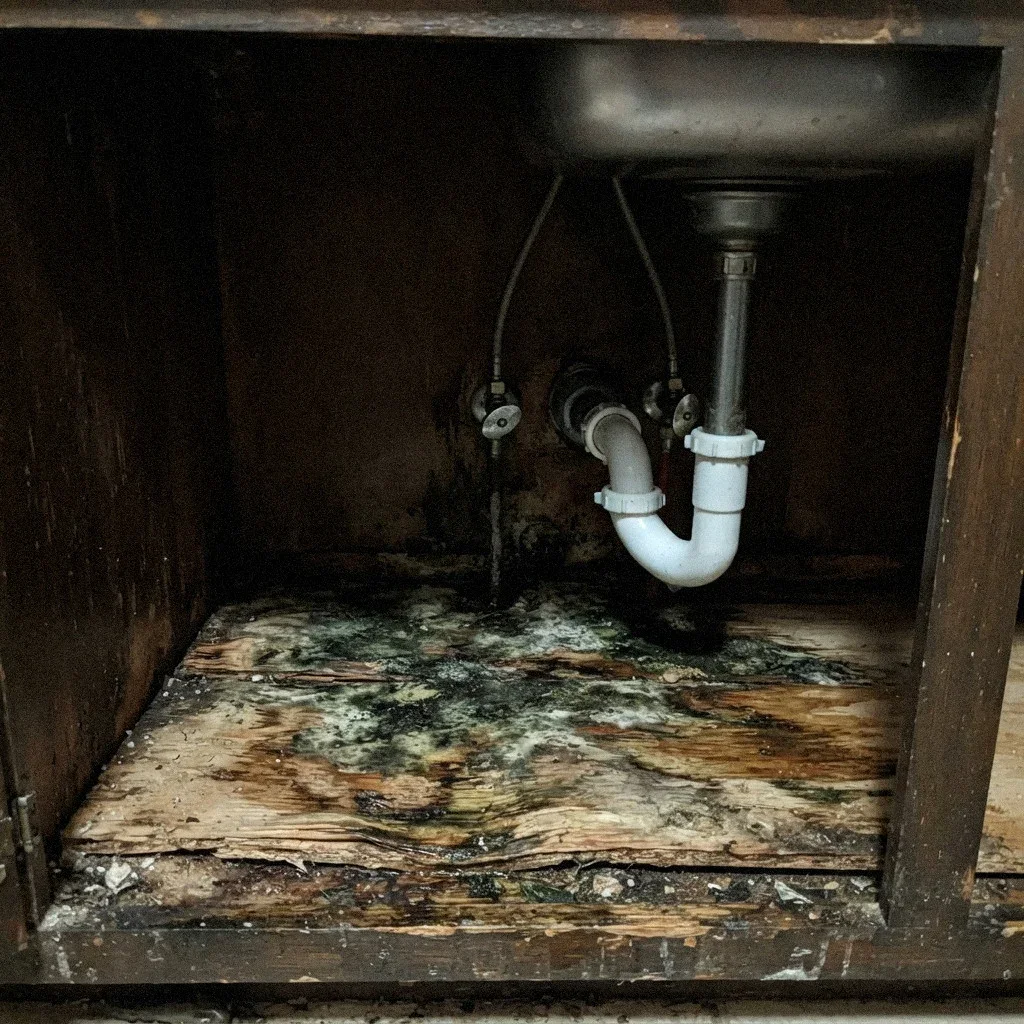
Color Tells You Nothing Useful
Marine layer humidity sits over much of coastal San Diego, from Ocean Beach to La Jolla, most mornings regardless of season. That humidity gets pulled indoors through open windows and uninsulated walls, giving materials enough moisture to support growth without a single drop of rain falling.
Many older homes near North Park and Normal Heights sit on raised floors over a crawl space, and pre-1950s construction in that era commonly has limited ventilation down there. Ground moisture collects, relative humidity stays high, and growth establishes on the underside of flooring before anyone notices.
San Diego's mold pattern is unusual next to most of the country: the marine layer that cools mornings from roughly May into August can feed indoor growth without a drop of rain falling. A house can pick up a damp corner in the driest month of the year. That is why the moisture source matters more than the calendar here.
Why Bleach Doesn't Finish the Job
- Common Sites
- Bathroom grout, closed closets, drywall near a slow leak, and cabinets under a condensate line from the air handler.
- Appearance
- Dark green to black speckling or a solid stain, often soft or slightly raised on paper-faced drywall.
- Smell
- A musty, earthy odor from active microbial growth, usually stronger in closed rooms with poor airflow.
- Health Note
- A common name for dark-colored fungal growth, not a single confirmed species; color alone never identifies what is actually growing.
- Removal Plan
- Same as any mold: cut out the porous, affected material, fix the moisture, verify with post-remediation testing.
- Growth Driver
- San Diego does not have a spring-to-winter mold calendar the way wetter climates do. Growth here tracks marine humidity and moisture intrusion year-round, from a foggy morning in Pacific Beach to a blocked condensate line in Mission Valley, not a rainy season.
- Follow-Up
- an estimated $1400–$6000
What Waiting Costs
Dark mildew on bathroom grout, soot from a candle, or a water stain left behind after a slab leak dried out. All can look black in low light. Grease film near a Convoy Street kitchen exhaust is another common lookalike, especially on textured ceiling paint where shadows exaggerate the color. A mold assessor checks for texture and moisture history rather than relying on color. Actual growth is usually slightly raised or fuzzy and tied to a damp material; stains and soot are flat and dry to the touch. Dampness nearby, not the shade of black, is what points to microbial growth.
What Remediation Involves
Removal follows the material, not the species. Drywall, insulation, and other porous material affected by growth typically get cut out and replaced rather than cleaned, because cleaning does not reliably remove what has grown into the material itself.
Containment during remediation keeps spores from spreading into the rest of the house while affected materials are removed. Post-remediation verification afterward confirms the area is clear before a mold assessor signs off and rebuilding starts.
Bleach changes the color you are looking at, not the colony underneath it. It kills what the wipe touches and leaves roots in the material behind. If the wall board or the framing stayed damp, the same patch returns in weeks, which is why the fix has to start with the water source, not the stain.
A LICENSED PRO VERSUS A GENERAL HANDYMAN FOR THIS JOB
| What you are dealing with |
What normally fits |
|---|
| Growth does not wait for a season here, since the marine layer keeps interior air damp through months when no rain falls at all. A house can pick up mold in the driest stretch of summer if a surface stays cool enough for condensation to form and linger. | Mold needs moisture more than it needs anything else. Organic material to feed on is already present in nearly any building material, so the question worth asking is not whether mold could grow but where the water or the humid air is getting in. A quote that skips that question is pricing half the job. |
| Color does not identify a species, and it never told anyone whether a patch is dangerous. Black, green and white growth can be the same organism reacting to different surfaces. A lab can name what is growing; it cannot say whether that name matters more than finding and stopping the water feeding it. | Mold needs moisture, not rain. In San Diego, marine humidity meeting a cool wall or window does the work a storm would do elsewhere, so a house can grow mold through a dry summer. Color does not tell you the species, and no test proves the air is safe. Find the water source before anyone starts cleaning. |
| A dark patch on drywall is a symptom, not the diagnosis. Every case traces back to a specific source: condensate off a cooling coil, a slow roof flashing leak, a bathroom fan venting into an attic instead of outside. Fix the surface without finding that source and the same patch returns within a season, often larger. | Mold needs moisture, not rain. San Diego's marine air meets a cool interior surface, an air conditioner drips condensate, a slow leak runs unnoticed because there's no wet season to expose it. No color identifies a species, no test proves the air is safe, and bleach only bleaches. The licensed pros we connect you with start by finding the water, not the stain. |
NO STATE LICENSEThis page describes identification only, not remediation steps or health outcomes. No state or federal agency sets a safe exposure limit for indoor mold, so nothing here should be read as a pass or fail result. A mold assessment by a qualified professional is the way to get findings specific to a given house.
What a Straight Quote Actually Looks Into
Black mold usually describes color, not one species; several genera turn dark on drywall, grout, or wood. A mold assessor identifies the affected material and moisture source. The remediator removes what the water damaged, whatever the species turns out to be.
What a Bottle of Bleach Cannot Fix
Small, hard-surface patches can sometimes be cleaned by a homeowner, but bleach treats the color on the surface, not growth inside a porous material like drywall. If it has spread across more than a small area, or keeps returning, that is a sign the moisture source was never fixed.
What It Means for the People Inside
Recognized effects tie to respiratory and allergic response: asthma symptoms, hay fever, irritation, worse for people already sensitized. No species is known to cause a specific disease, and no test result can be measured against a safe exposure level, because no federal or state authority sets one.
Wondering If The Smell Is Mold?
Most black mold jobs in San Diego land between an estimated $1400 and $6000, and the property decides where inside that. What moves the price on this page is almost never the mold itself — it is what the water reached and how much of it has to come out. Surface growth on tile or paint in a well-ventilated bathroom is the cheap end. The same size patch on drywall with insulation behind it is a different job, because porous material is removed rather than cleaned and the area has to be contained while that happens. Get the cause identified before you compare two quotes, or you are comparing two different scopes. pricing guide, and the service that handles this is Black Mold Removal.
Cost depends on how much porous material has to come out and how hard the moisture source is to reach, not on which species is present. A patch behind an accessible wall in Kearny Mesa costs less to address than growth spread through ductwork or a crawl space.