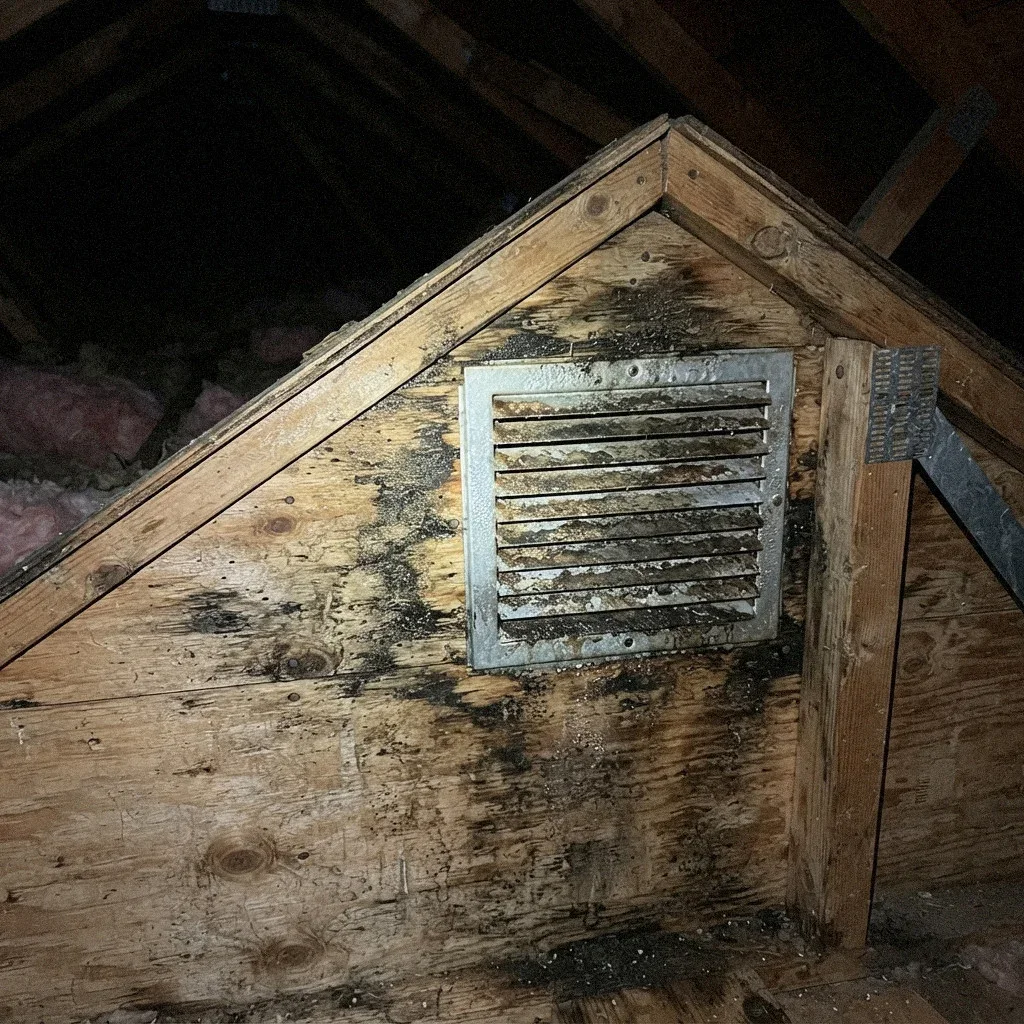
Color Tells You Nothing Useful
San Diego's marine layer keeps indoor humidity higher than the dry summer air outside would suggest, and older homes in Kensington and Talmadge with single-glazed aluminum windows collect condensation that soaks into wood sills — exactly the wet cellulose Fusarium favors.
Fusarium turns up in water-damaged wood, wet insulation, and standing water left in a clogged condensate pan. San Diego homes with older AC units in Clairemont or Linda Vista see it where drain lines back up unnoticed for weeks.
Marine air off the Pacific cools against interior surfaces year round, so growth in San Diego answers to humidity, not to storm counts. A stretch with zero rainfall can still leave a dark ring at a ceiling corner or a musty closet. Ask what is feeding the moisture before anything gets scrubbed or painted over.
What the House Era Tells You
- Appearance
- Pink, white, or reddish patches on wet drywall, carpet, or wood, sometimes with a musty odor.
- Where It Grows
- Grows readily on water-damaged porous material once relative humidity stays elevated for more than a day or two.
- Health Notes
- Often a pink, white, or reddish growth on wet drywall or trim after a slab leak or window condensation event.
- Testing
- No published exposure limit exists, so no air or surface sample can be read against a safe number.
- Removal
- Same as any porous-material growth: remove affected material, dry the structure, confirm the moisture source is fixed.
- Growth Driver
- San Diego does not have a rainy season that drives mold the way a wetter climate does. Fusarium growth here tracks marine layer humidity and mechanical moisture — condensate, slow leaks, poor ventilation — more than the calendar.
- Follow-Up
- an estimated $1100–$3900
What Waiting Costs
Fusarium is often confused with Stachybotrys, since both can show up pink-to-reddish or dark on water-damaged wood and drywall and both get called toxic mold online. They are different organisms with different growth habits, and neither claim about toxicity is something a visual inspection can confirm. Both grow on wet cellulose, both spread across a damp patch rather than staying in one spot, and neither has a color reliable enough to name from across a room. A mold assessor can sample and identify the genus, but doing so does not change how a remediator plans the removal.
Drying Before Anything Is Rebuilt
Removal is driven by the material, not the genus. Porous material soaked by a leak in a Serra Mesa or Linda Vista home generally comes out; a mold remediator does not treat Fusarium differently from other growth on the same drywall or subfloor.
The moisture source gets addressed alongside the growth — a condensate line cleared, a slab leak found, ductwork resealed — because leaving relative humidity unmanaged in the affected area lets any microbial growth return once containment comes down.
Bleach changes the color you are looking at, not the colony underneath it. It kills what the wipe touches and leaves roots in the material behind. If the wall board or the framing stayed damp, the same patch returns in weeks, which is why the fix has to start with the water source, not the stain.
WHAT A REMEDIATION QUOTE SHOULD INCLUDE VERSUS SKIP
| What you are dealing with |
What normally fits |
|---|
| Mold needs moisture, not rain. San Diego homes grow it through a dry summer just as easily as a wet winter, because humid marine air meeting a cool surface, or a leaking AC line, does the same job water would elsewhere. No exposure limit exists to test against. Color tells you nothing about species. The real question is always where the moisture is coming from. | Bleach changes the color of mold on a surface without addressing why it grew there. Left alone, the moisture behind it keeps feeding new growth in the same spot or the one next to it. The useful work is finding the damp source first, then deciding what removal the material actually needs. |
| Mold in San Diego rarely traces back to rain. It traces back to a surface that stays cool and damp longer than the air around it — a window, a closet wall, a duct running through humid air. Any pro who prices the job without asking what stays wet, and why, is pricing on a guess rather than the actual cause. | Color tells you almost nothing. A patch on drywall near Chollas Creek and a patch in a Clairemont hallway can be the same species or different ones, and a homeowner cannot tell by looking. What matters is how large the patch is, how long it has been damp, and whether the water source got fixed. Everything else is guessing. |
| A quote that skips the moisture source is only half a quote. Bleach changes the color of a stain, not the growth underneath it, so a clean-looking wall after a bleach wipe is not a solved problem. The licensed pros we connect you with should explain the source before pricing the cleanup. | Mold needs moisture, not rain. That single fact matters most in a city where a house can grow mold through a dry summer, no rain at all, because marine air meets a cool interior surface or an air conditioner drips where nobody looks. No published safe exposure level exists. The question worth asking is where the water is coming from. |
NO STATE LICENSEContractors doing this work hold Contractors State License Board classifications rather than a mold-specific credential, since none exists in California. No inspection can confirm indoor air meets a legal standard, because no such standard is written into law.
What a Straight Quote Actually Looks Into
Fusarium growth in San Diego homes usually shows on water-stained drywall, wet carpet padding, or damp wood near a slab leak or condensate leak. Removal follows the same path as any other growth: cut out the affected porous material, dry the structure, verify the moisture source is gone.
The Moisture Problem DIY Skips Past
A patch smaller than about a square foot on tile or sealed wood can sometimes be wiped by a homeowner, but Fusarium on drywall, insulation, or subfloor usually means the material itself needs to come out, not be scrubbed.
What It Means for the People Inside
Fusarium turns up on chronically wet material — trim near a slab leak, subfloor under a slow leak, sometimes ductwork insulation. It can look pink, white, or pale tan, which overlaps with other genera, so a mold assessor identifies it under a microscope rather than by color. No exposure limit exists for indoor mold, so no air sample gets compared against a safe number. Recognized effects are respiratory and allergic. Removal follows the material, not the species.
Wondering If The Smell Is Mold?
Most fusarium jobs in San Diego land between an estimated $1100 and $3900, and the property decides where inside that. What moves the price on this page is almost never the mold itself — it is what the water reached and how much of it has to come out. Surface growth on tile or paint in a well-ventilated bathroom is the cheap end. The same size patch on drywall with insulation behind it is a different job, because porous material is removed rather than cleaned and the area has to be contained while that happens. Get the cause identified before you compare two quotes, or you are comparing two different scopes. pricing guide, and the service that handles this is Mold Remediation.
Cost depends on which materials absorbed the water and how far the moisture traveled behind walls or under flooring, not on the genus identified. A mold assessor's findings on extent matter more to the estimate than the name of what is growing.