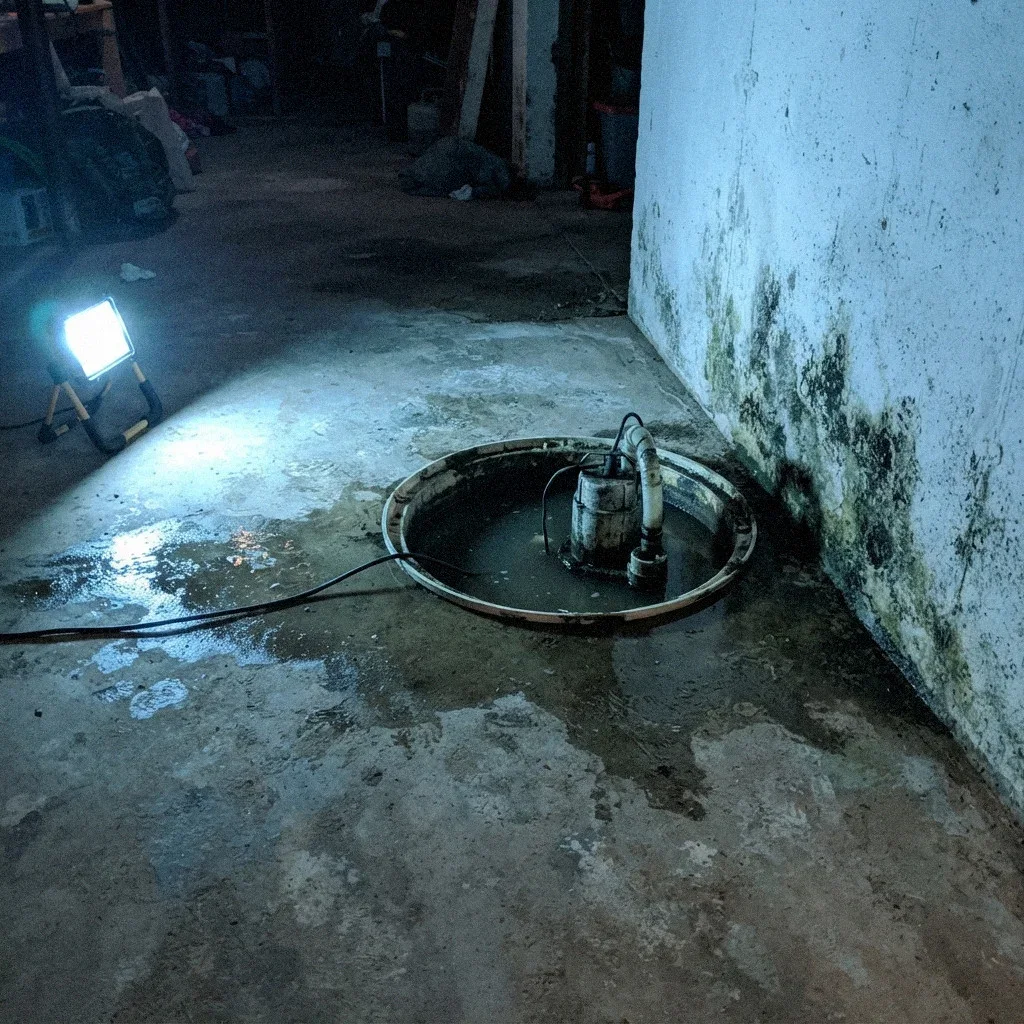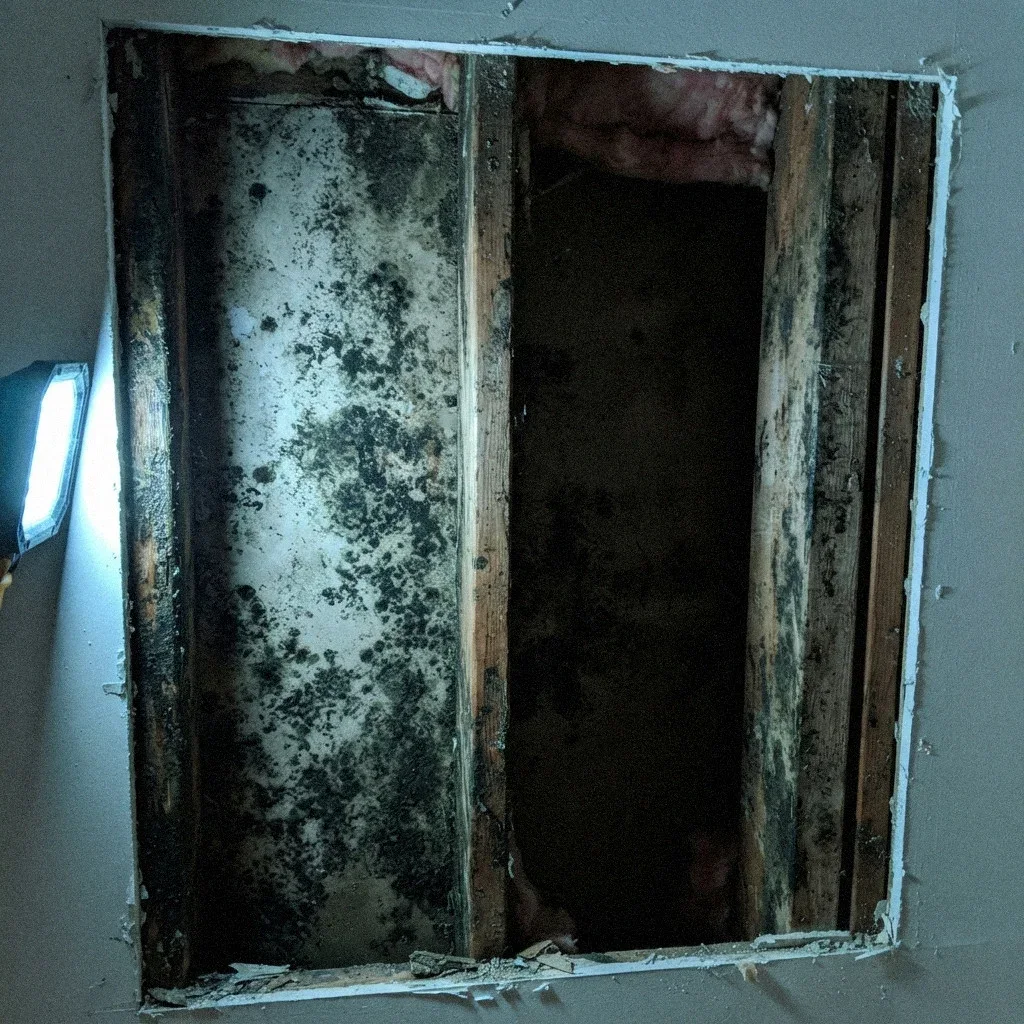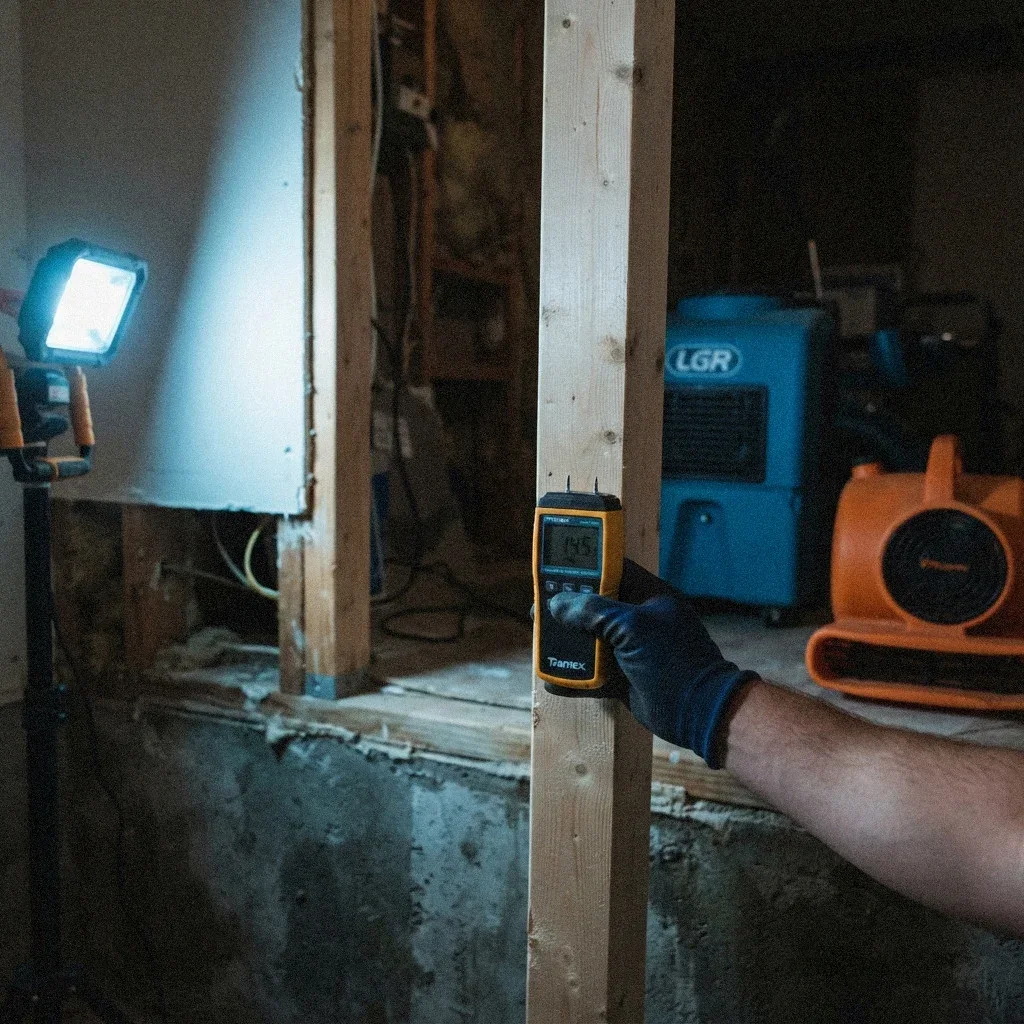
A moisture meter shows up on almost every mold inspection in San Diego, and almost nobody explains what the number means. It does not detect mold. It measures moisture content in wood, drywall or plaster, and that number matters for one reason: mold needs damp material to keep growing. A high reading next to a dark patch on a wall in North Park or Kensington tells you the water problem is still active, not finished.
Pin Versus Pinless Meters
A pin meter uses two small probes pushed into the material, reading resistance between them, which gives a fairly precise number at a specific depth. A pinless meter uses a sensor pad pressed flat against the surface and reads a wider area without marking it, useful on painted drywall or trim you don't want to puncture. Neither is more correct. A penetrating probe reaches deeper into a stud or sill; a pinless pass is faster for scanning a whole wall in a Kensington or Talmadge bungalow.
What a Reading Proves
A single number off a moisture meter proves almost nothing on its own. Eleven percent means something different in a pine sill than it does in drywall, because material density changes how the meter reads. What a reading does prove, reliably, is a comparison: this stud is wetter than that one. That comparison is the actual tool. Without it, a number is just a number sitting on a page with no context to judge it against.
What a Reading Cannot Prove
A moisture meter cannot tell you whether the air in a Golden Hill or South Park home is safe to breathe, and it cannot identify what is growing on a damp patch of drywall. It cannot say how long a wall has been wet, only that it is wet now. Treating a moisture reading as a health verdict is a mistake worth naming directly, because no reading, high or low, answers that question.
The Reference Reading Habit
The useful move on a mold job is taking a reading on the suspect wall, then taking one on an unaffected wall nearby, ideally the same material and the same orientation. That second number is the baseline reading, and it turns an isolated figure into something meaningful. A stud reading 18 percent means little by itself; a stud reading 18 percent next to one reading 9 percent in the same Clairemont or Bay Park house means the first one is actually wet.
No Universal Dry Number
There is a habit borrowed from the water damage trade of chasing a fixed dry standard, a target percentage the material has to reach before a job is considered finished. That framework belongs to drying out a flood, not to a mold question. For mold, the relevant question is narrower: is this material still wet enough to support growth right now, compared to material nearby that never got wet at all.
Wood Moisture Equivalent
Meters built for wood are calibrated against wood moisture equivalent, a scale developed for lumber. Point that same meter at drywall or plaster and the number shifts because those materials don't hold or release water the way wood does. Most meters offer a relative scale for non-wood materials instead of a true percentage, which is one more reason a single reading needs a comparison point rather than a fixed threshold to be judged against.
Calibration and Drift
A moisture meter drifts out of calibration over time, and a poorly calibrated one will read consistently high or low across everything it touches, which sounds like a problem until you remember the comparison method. If both the suspect wall and the unaffected reference wall are read on the same drifting meter, the gap between them still holds. That's part of why the pros we connect you with lean on the comparison rather than the raw figure.
Where This Shows Up Locally
In older San Diego housing stock, single-glazed aluminum windows run with condensation on cool mornings, and a moisture meter reading near the sill or the surrounding drywall often shows elevated moisture there before anywhere else in the room. A blocked air conditioning condensate line is another pattern worth checking with a meter, since it backs water into a ceiling or wall cavity below the air handler long before a stain appears on the surface.
Surface Reading, Hidden Cavity
A pinless meter reads the surface and a shallow layer beneath it, which means a dry-looking wall in a Serra Mesa or Allied Gardens home can still hide a wet stud cavity further in. That's a reason a pin meter sometimes follows a pinless scan, going deeper at the specific spot the surface reading flagged, rather than relying on one tool alone across the whole wall.
Meters Do Not Replace Judgment
A moisture meter is one input, not a verdict. The pros we connect you with combine a reading against a reference point with a visual look at the material, the extent of any visible growth, and where the water is likely coming from. Chasing an exact number without asking where the moisture originated is quoting on half the problem, whether that's in a Talmadge cottage or a Mira Mesa townhome.
Read the Fuller Guide
This page covers the meter itself. The broader question of what mold removal actually involves, from inspection through containment, gets a full treatment elsewhere on this site. If a moisture reading has already turned up a wet wall in your home, that guide is the next useful thing to read, and it goes further than a single blog post reasonably should.
Dealing with this in your home?
Mold in San Diego rarely starts with a storm. Marine air off the coast meets a cool interior surface, or an air conditioner drips quietly behind drywall, and growth begins without a drop of rain. A 1950s tract house near Clairemont Mesa Boulevard and a Craftsman near South Park fail the same way: moisture first, staining second. Bleach handles the color. It does not handle the source.